

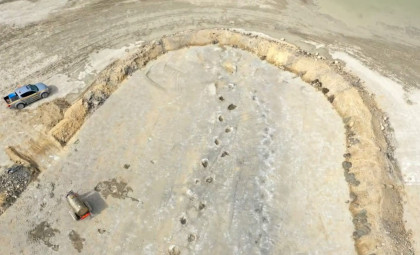
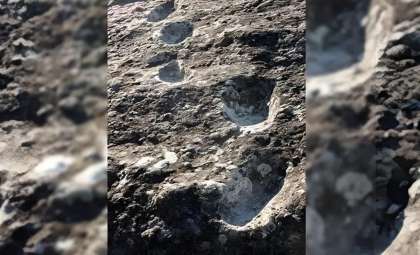
An enormous dinosaur left a trackway dated back 150 million years that offers intriguing insights into its locomotion. More than 130 fossilized footprints found in Colorado capture a sauropod tracing a full circle, with subtle differences in stride suggesting an uneven gait. This remarkable trackway was uncovered at the West Gold Hill Dinosaur Tracksite, near Ouray, Colorado, and stands as one of the rarest complete curved sauropod trails ever documented.
Covering a distance of 95.5 meters, this pathway provides an exceptional record of a single dinosaur's movements, far more detailed than typical fossilized track finds. Originating in the Late Jurassic era, when huge long-necked creatures like Diplodocus and Camarasaurus roamed North America, this trail offers unique perspectives. According to Dr. Anthony Romilio from the University of Queensland’s Dinosaur Lab, the track is extraordinary because it shows the dinosaur forming a full loop before continuing in its original direction.
Rather than merely tracing where the dinosaur traveled, the tracks reveal how it moved, with variations in stride length and spacing offering clues about its gait and possible physical condition.

Insights from an Ancient Trackway Showing a Full Turn
The fossilized pathway unveils a surprising motion pattern of the dinosaur. Researchers determined the animal initially headed northeast, then curved around to complete a full loop, and proceeded in its initial direction. This full circle makes the discovery particularly valuable for studying locomotion. Shorter trails might capture only a handful of steps, but this extended sequence illustrates how the walking pattern shifted during the turn.
“This trackway is unique because it is a complete loop,” Dr. Anthony Romilio said. The preserved path allowed scientists to examine how a massive sauropod handled a tight curve before returning to its original course.

Despite this unique path, the reason why the dinosaur circled back remains a mystery. The footprints do not provide a clear explanation but capture an exceptional moment of dinosaur behavior.
Drone Technology Maps the Extensive Tracksite
The vast scale of the West Gold Hill Dinosaur Tracksite posed challenges for documentation on the ground. Scientists employed drones to photograph the full extent of the footprints and their layout. Dr. Paul Murphey at the San Diego Natural History Museum explained these aerial images were key for building a high-resolution 3D model of the trackway.
“It has been challenging to document these footprints from the ground because of the size of the trackway,” he explained. “With these images we generated a detailed 3D model, which could then be digitally analyzed in the lab at millimeter-scale accuracy.”

As reported in the study published in Geomatics, reconstructing the entire step sequence allowed researchers to analyze different segments of the trail. This showed how the dinosaur’s movement naturally adapted throughout the curve and highlighted why analyzing complete trackways is important. Isolated sections might not represent typical walking patterns, but a full trail can expose consistent behaviors.
Dinosaur’s Uneven Steps Suggest Potential Limp or Preference
One of the most intriguing observations came from measuring the spacing between the footprints. The width between left and right tracks changed along the path, alternating between narrow and broad patterns. This reveals that footprints do not always record uniform strides, meaning partial tracks could give an incomplete view of movement.
In addition, the dinosaur’s left and right strides varied slightly but consistently by roughly 10 centimeters (around 4 inches). This small discrepancy could indicate a limp or simply a natural preference for one side of its body, though the footprints alone can’t conclusively determine the cause.
Backed by the U.S. Forest Service, this research illustrates how fossilized trails can capture behavioral aspects of dinosaurs, not just their presence.
“There are many long dinosaur trackways around the world where this method could be applied to extract behavioral information that was previously inaccessible,” concluded Romilio.
- Categories:
- Science



0 comments
Sign in to Comment