

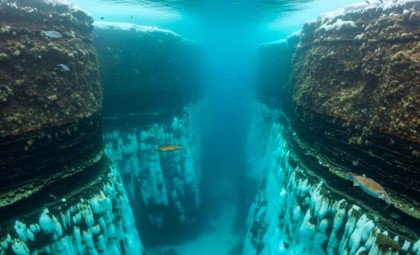
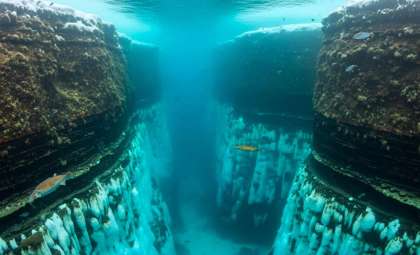
Researchers uncovered a staggering 150-foot-long siphonophore, potentially the longest marine creature ever documented, during a month of exploration in submarine canyons off Western Australia's Ningaloo coast. Alongside this colossal find, the expedition identified nearly 30 previously unknown marine species, including some of the deepest-dwelling fish and invertebrates recorded for the region.
The mission took place aboard the Schmidt Ocean Institute’s research vessel Falkor, led by Chief Scientist Dr. Nerida Wilson from the Western Australian Museum. Experts from Curtin University, Geoscience Australia, and the Scripps Institution of Oceanography collaborated on this project in the Indian Ocean’s Ningaloo Canyons.
This expedition is part of a broader year-long campaign by the institute, involving multiple international science and engineering teams exploring Australia and the Pacific. Utilizing an advanced underwater robot, scientists gained unprecedented access to deep ocean canyons and coral reefs previously unexplored.

Enormous Colonial Organism Revealed
The standout discovery was a siphonophore—a mobile colony comprised of thousands of cloned zooids specialized for different roles. Together, these tiny organisms form an extensive, jelly-like chain, here measuring roughly 150 feet in length.
The crew documented the largest recorded specimen of the giant siphonophore Apolemia and shared footage on Schmidt Ocean Institute’s Twitter. Wilson remarked:
“We suspected these deep sea areas would be diverse but we have been blown away by the significance of what we have seen.”

Robotic Exploration Unveils New Depths
Using the remotely operated vehicle (ROV) SuBastian, the team conducted 20 deep dives, reaching depths of up to 4,500 meters and accumulating more than 180 hours of underwater research. They retrieved the first giant hydroid specimens from Australian waters and discovered extensive glass sponge colonies in Cape Range Canyon.
The researchers documented several marine species new to Western Australia, including the bioluminescent Taning’s octopus squid, the long-tailed sea cucumber, and numerous mollusks, barnacles, and squat lobsters.
Some collected creatures will be displayed at the Western Australian Museum. Dr. Lisa Kirkendale, the museum’s aquatic zoology head and co-lead investigator, emphasized the importance of these finds:
“These specimens represent so many extensions in depth and range records for so many species, and will form an important new part of WA Museum collections.”
Building a Lasting Scientific Archive
The Falkor vessel, operated by Schmidt Ocean Institute, a non-profit founded by Eric and Wendy Schmidt in 2009, stands as the only fully philanthropic research ship conducting year-round ocean studies globally. Data and specimens from this expedition will be publicly available.
This pioneering research will enable formal naming of many new species and aid in refining ROV monitoring techniques for Australia's marine protected areas. It will also support environmental DNA sampling in the Indian Ocean’s deep waters. Dr. James Findlay, National Parks director, praised the effort:
“Ongoing scientific exploration is vital to the effective management of our marine parks, and we are committed to partnering with other agencies to record and monitor these precious places.”
Wendy Schmidt, co-founder of Schmidt Ocean Institute, highlighted the expedition’s broader significance, pointing out the interconnectedness of oceanic and terrestrial ecosystems.
“There is so much we don’t know about the deep sea, and there are countless species never before seen,” she said, adding that “the Ningaloo Canyons are just one of many vast underwater wonders we are about to discover that can help us better understand our planet.”
- Categories:
- Science



0 comments
Sign in to Comment