

Researchers in China have uncovered a rare fossil that offers unprecedented insight into a marine reptile from approximately 245 million years ago. This exceptional find includes a nearly complete skeleton along with most of its digestive tract, marking the oldest reptile fossil with a well-preserved internal system known to science.
This discovery provides a unique chance to examine both the external form and internal organ structures of an ancient marine reptile. Published in Science Advances, the research focuses on Austronaga minuta, a small, long-necked species whose exceptional fossilization exposes rarely seen anatomical details from the Triassic era.
The international team features experts from China, Europe, and the U.S., including paleontologist Dr. Stephan Spiekman from the State Museum of Natural History Stuttgart and the University of Hohenheim. Their findings not only delineate the anatomy of this individual creature but also shed light on the adaptation processes of reptiles transitioning from land to marine environments.

Distinctive Adaptations of an Early Ocean Dweller
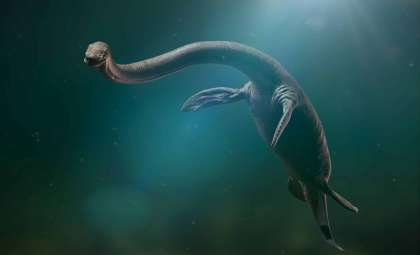
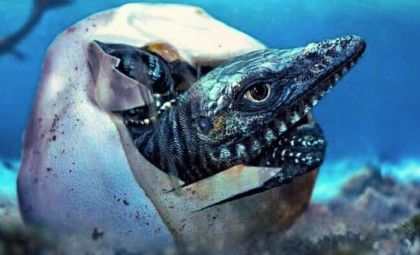
The Austronaga minuta specimen measures approximately 60 centimeters (24 inches) long and is nearly intact. Despite its modest size, this reptile stood out among Triassic marine species due to its unusually extended neck and tail.
Evidence indicates that the animal was already well adapted for life in water. Its elongated tail provided thrust, while fin-like forelimbs helped with navigation and balance. Conversely, its hind limbs were greatly diminished and played a minimal role in locomotion.
Surprisingly, its evolutionary lineage contrasts with its physical form. Although its body shape is reminiscent of marine reptiles like ichthyosaurs and mosasaurs, Austronaga is more closely related to early archosaurs — the group that eventually evolved into dinosaurs and crocodiles. Dr. Stephan Spiekman noted that prior assumptions held early archosaurs as having limited marine adaptations, stating:
“The discovery of Austronaga shows that early representatives of this lineage had already developed complex adaptations to life in the oceans, comparable to those of other, better-known groups of fossil marine reptiles.”
Remarkably Preserved Internal Organs
The most extraordinary aspect of this fossil lies within its rib cage. A darkened region nestled among the ribs was identified as a nearly complete digestive system, uncovered through cutting-edge investigative methods.
The team used UV light imaging and mass spectrometry to pinpoint various internal organs, including a sizable sac-like stomach, a liver preserving traces of hemoglobin, and an extended digestive tube corresponding to the intestines.
Lead researcher Dr. Wei Wang of Beijing's Institute of Vertebrate Paleontology and Paleoanthropology remarked that the reptile’s internal structure appeared less specialized than its external skeleton. While clearly adapted for aquatic movement, its digestive design remained quite straightforward.
“The overall arrangement shows that the digestive system of Austronaga was relatively simple in structure. This fossil is the oldest known example of a largely complete digestive system in a reptile,” he said.
Insights Into Archosaur Evolution
The preserved internal organs also provide fresh perspectives on archosaur evolution. Unlike modern birds and crocodilians, which have a stomach partitioned into two chambers, Austronaga only possessed a single stomach chamber.
Nick Fraser from National Museums Scotland highlighted that this suggests the earliest archosaurs started with a simpler digestive setup, with the dual-chamber stomach evolving subsequently.
He further pointed out that Austronaga featured a short and uncomplicated digestive tract similar to those in contemporary fish-eating reptiles. Alongside the skeletal remains, this fossil offers one of the clearest portraits of early marine reptile biology.

Currently preserved in Beijing, the fossil aids ongoing investigations into the variety of reptiles that thrived in Triassic oceans. The research team anticipates future finds will further illuminate the evolutionary pathways of ancient marine reptiles and their land-based kin.
- Categories:
- Science

0 comments
Sign in to Comment