

Nearly 94 years after discovery of its lower half, the colossal statue of Ramesses II has been fully restored and returned to its ancient home in Egypt. Towering 22 feet tall and weighing more than 40 tons, the monument now proudly stands again at the northern gateway of the temple at Hermopolis Magna, where it was originally erected over 3,200 years ago.
The artifact's tale began in 1930, when German archaeologist Günther Roeder uncovered the statue’s base near present-day El Ashmunein, located about 150 miles south of Cairo. Known in antiquity as Khemnu, this site later became Hermopolis Magna under Roman dominion, a prominent city of the Middle Kingdom.
For decades, the statue’s upper segment remained missing, presumed buried beneath the surrounding desert. Its recent unveiling marks the first completely reunited colossal statue from Middle Egypt, also representing a milestone as the earliest example examined with contemporary archaeological techniques.

Unexpected Find Just Before the Official Reveal
The missing portion of the statue was actually excavated weeks prior to the March 2024 announcement by an Egyptian-American archaeological team. In an interview with Reuters, representatives from Egypt’s Ministry of Tourism and Antiquities described the fragment as approximately 12.5 feet tall, portraying Ramesses II donned with a royal cobra-adorned headdress.
While experts anticipated further significant discoveries at Hermopolis Magna given its rich archaeological potential, the exact location of this find was a surprise. According to co-lead Yvona Trnka-Amrhein, assistant professor at the University of Colorado Boulder, the team was aware such a fragment could exist but hadn’t been actively searching for it at the time.

Challenges From Water Near the Nile
Proximity to the Nile River posed a threat to the artifact’s preservation during excavation. Trnka-Amrhein explained in a press release that water table fluctuations caused by the Aswan Low Dam’s construction had previously endangered the site, saying:
“One problem with Hermopolis is that it’s close to the Nile. After [the building of] the Aswan Low Dam, the water table became a huge issue. There was no guarantee that the stone would be OK,” she said. “Sometimes sandstone is uncovered that is basically just sand or degraded limestone. It could have just been a lump of rock.”
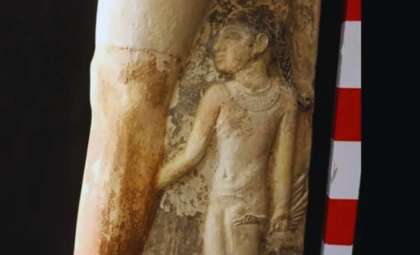
Subsequent digs revealed the upper piece was exceptionally well maintained. Remarkably, traces of blue and yellow pigments remained visible, a rare discovery that may offer insights into the statue’s original appearance and the artistic practices of its era.

The Next Chapter: Restoration and Beyond
Following a restoration proposal by Egyptian co-leader Basem Gehad, the Permanent Committee for Ancient Egyptian Antiquities gave the green light to reunite the two fragments. The restoration began in September 2025, and by early 2026 the statue was fully reconstructed and reinstated at its original location near the temple’s northern entrance, as detailed by Hyperallergic.
The monument was reconstructed from four principal components: the upper and lower body portions plus three inscribed stone bases seated on unhewn foundation blocks. This achievement marks it as the first fully intact colossal statue from Middle Egypt subjected to advanced archaeological analysis.

This work is part of the broader City of the Baboon Project, an initiative combining efforts from Egypt’s Ministry of Tourism and Antiquities with the University of Colorado Boulder’s classics department. Upcoming expeditions planned for 2026 and 2027 aim to uncover additional temple structures and other artifacts still buried at Hermopolis Magna.
- Categories:
- Science

0 comments
Sign in to Comment