

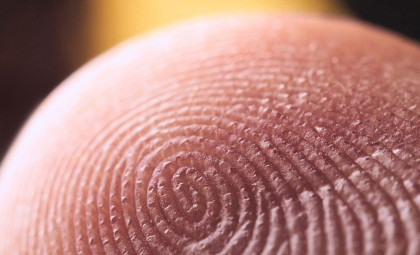
For more than a century, fingerprint analysis has relied on the assumption that each fingerprint’s ridge pattern is unique. However, a novel artificial intelligence system doesn’t dispute this but reveals a new insight: fingers from the same hand exhibit structural similarities that previous forensic approaches often overlooked.
This discovery prompts a shift in focus toward a different challenge: instead of determining whether two prints belong to the same finger, the AI seeks to establish if two distinct fingerprints could have originated from the same person.
The essence of this study shows a significant probability that ridge patterns on different fingers of one individual share similarities, even when traditional methods would consider a match unlikely.

This approach could introduce a fresh tactic for linking evidence across crime scenes. Typically, investigators search for identical prints on multiple scenes, but standard methods struggle to associate prints from different fingers of the same individual.
Using an AI model that detects cross-finger similarities might enhance investigative capabilities by connecting prints previously thought unrelated.
Hidden Clues Within the Ridge Flow
Fingerprint identification usually involves examining specific minutiae such as ridge endings, bifurcations, and unique pattern shapes, all crucial for distinction between prints.
These refined details assist forensic experts in telling apart one print from another.
However, shifting the goal to link different fingers’ prints revealed that these minutiae offer limited assistance.
Instead, valuable data emerged from examining ridge orientation, particularly in regions where ridge directions shift abruptly. The AI leverages overall ridge flow and geometric properties, moving beyond just minute details typical in conventional fingerprint comparisons.

By analyzing various modified fingerprint images, researchers uncovered what drives the model’s predictions. It maintained its accuracy with ridge-based images and orientation maps, whereas minutia-focused maps were far less effective for cross-finger matching.
This illustrates that fingerprints encompass an additional dimension of information. Features that distinguish individual fingers do not always reveal if those fingers belong to the same owner.
Moreover, the AI concentrated on delta regions—where ridges change direction—and known fingerprint categories like loops, arches, and whorls. While these patterns provided some insight, they didn’t fully explain the network’s detected relationships.
Confirming Similarities Across Thousands of Prints
The team trained and evaluated the model using large fingerprint collections containing tens of thousands of samples.
A primary resource was the NIST SD300 database, maintained by the U.S. National Institute of Standards and Technology, containing both plain and rolled prints. Access was granted under specific research-use agreements.
They also utilized the RidgeBase benchmark dataset from the University at Buffalo, featuring over 15,000 fingerprint pairs from 88 individuals captured via contact sensors and smartphones.
Overall, researchers processed around 60,000 real fingerprints for training, testing, and validation, complemented by synthetic prints used to teach meaningful fingerprint characteristics before examining actual cross-finger patterns.
Comparison of prints from the same person versus different individuals showed a clear statistical distinction. The study calculates a 99.99% confidence level that the detected cross-finger resemblances are not coincidental.
It’s essential to clarify this figure reflects statistical proof of cross-finger similarity presence, not an identity-matching accuracy rate. Results confirmed strong differentiation even between fingers on opposite hands.
Enhancing Crime Scene Investigations
While not designed to replace standard fingerprint matching, this innovation introduces a supplementary mechanism for crime scene analysis. Traditional methods ignore the potential relation between prints from separate fingers found at different crime scenes.
By applying an AI tuned to large-scale ridge patterns, investigators might establish connections between such prints, aiding in suspect identification.
Thus, this technology is better suited for helping generate investigative leads rather than delivering definitive proof of identity.

The research demonstrated that tools leveraging this AI can help filter vast databases of fingerprints collected from various crime scenes, narrowing suspect lists faster than traditional manual comparison allows.
Such automated systems won’t confirm guilt or identity but can speed up investigations by focusing forensic efforts more efficiently based on these novel fingerprint correlations.
Challenges Between Research and Practical Use
Several constraints remain for real-world application:
First, this AI still performs less accurately than established methods when matching prints from the same finger.
Second, the research relied mostly on high-quality fingerprint images that were full and clear, unlike many real crime scene prints, which often are partial, degraded, smudged, or captured on difficult surfaces. These lower-quality images adversely impacted model performance.
Third, underlying demographic biases were noted. The team found the cross-finger signal appeared broadly consistent across diverse groups, yet some differences persisted, underscoring the need for further validations before operational deployment.
Overall, the findings reveal an unexplored informational layer within fingerprints beyond their uniqueness. The AI model uncovers wider ridge structure patterns that sometimes indicate shared origin from fingers of the same hand.
By posing a fresh forensic question—“could two different prints come from the same hand?”—this work equips law enforcement with alternative approaches for interpreting fingerprint evidence spanning multiple crime scenes.
- Categories:
- Science










0 comments
Sign in to Comment