

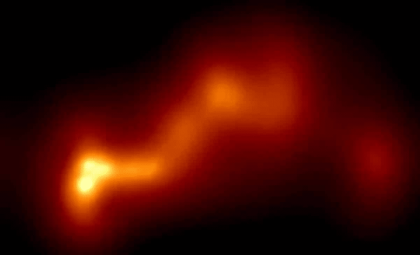
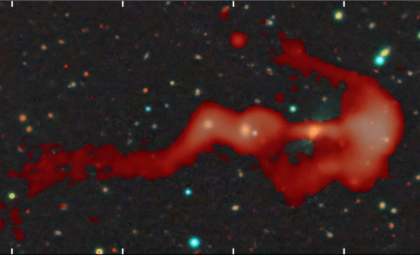
Using artificial intelligence to reconstruct continuous polarized videos, astronomers have uncovered new details about the plasma flow in supermassive black hole jets, challenging the idea that bright moving features are shock waves. This breakthrough research, published in Nature, analyzes years of radio data from the blazar 3C 345, offering unprecedented views of jet behavior near one of the universe’s most extreme objects.
Innovative Perspectives on Jet Evolution
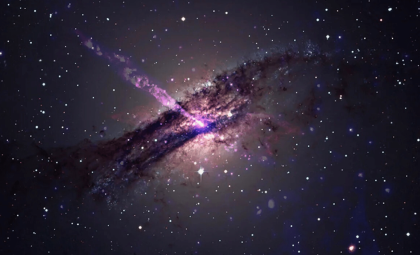
For many years, astronomers have employed Very Long Baseline Interferometry (VLBI) to observe enormous jets emitted by supermassive black holes at the centers of active galaxies. These measurements revealed bright structures within jets that seem to move faster than light—an effect explained by relativistic speeds and viewing angles.
While conventional radio imaging has provided critical insights, each observation is usually treated as a standalone snapshot, limiting understanding of jet dynamics over time.


Advanced algorithms have enhanced radio images, but producing continuous time-lapse videos from extensive, variable data sets remained a formidable challenge. The newly developed AI technique synthesizes data from numerous observations, learning the temporal evolution of jet structures.
This approach enables researchers to move beyond tracking isolated bright spots, instead revealing plasma dynamics throughout the entire jet, providing a richer understanding of jet mechanics.
Turning Radio Data Into a Dynamic Cosmic Film
The team introduced kine, a specialized video reconstruction algorithm for VLBI data of variable sources, which employs neural networks to connect spatial features across time.
Applying kine to 116 VLBI datasets from the blazar 3C 345, part of the MOJAVE monitoring program, they produced a continuous polarized video that captures jet changes over many years.
This method achieves approximately fourfold higher resolution than traditional imaging limits and delivers about 140 times greater image contrast. It allows precise measurement of plasma velocities throughout the jet, rather than just following the trajectories of bright knots.

The published work in Nature showcases the power of continuous imaging for uncovering intricate behaviors in distant astronomical phenomena. As the authors stated,
“Applied to multi-epoch observations, kine can provide marked advances in jet kinematics studies: from high-resolution time-continuous videos, it becomes possible to measure the instantaneous local velocity field rather than only tracking model-fitted components.”
By enabling an uninterrupted view of jet activity, kine opens new avenues for exploring the complex interplay between magnetic fields, radiation, and plasma around supermassive black holes.
Reconsidering the Nature of Bright Jet Structures
Analysis of blazar 3C 345 now calls into question the long-held interpretation that luminous, moving features within black hole jets are shock waves formed by plasma compression.
The classic shock wave model predicts that these bright regions should move at speeds distinct from the surrounding relativistic flow. The kine reconstruction allowed a detailed comparison between the motions of bright knots and neighboring plasma.

The results reveal that bright knots and the plasma around them travel at comparable speeds, implying these luminous features may not be separate shock fronts but regions brightened by localized magnetic energy variations and viewing angle effects.
Polarization measurements further undermine the shock wave explanation. The authors note,
“We found no evidence that traveling bright components are strongly shocked regions, as previously proposed, because the component speeds are of the same order as the average flow speed in the same regions. The shock interpretation is also disfavored by the absence of correlation between the bright features and the peaks in the fractional polarization.”
While this does not rule out shock waves in other black hole jets, it indicates that the bright, moving structures seen in 3C 345 might originate through different mechanisms than conventionally thought.
- Categories:
- Astronomy






0 comments
Sign in to Comment