

A skull fragment dating back approximately 224,000 years has been found in central Spain, shedding new light on early human populations inhabiting Europe during the Middle Pleistocene era. This fossil, named RVH-1, displays unique physical features, enriching our understanding of human evolution on the Iberian Peninsula.
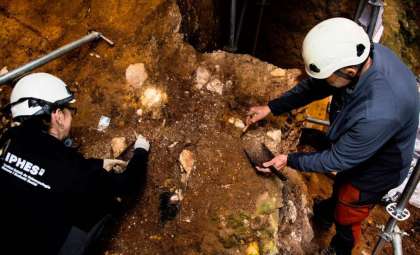
Excavations at the Ruidera Lakes Natural Park in the Castilla-La Mancha region led to the discovery of this remarkable find. RVH-1 represents the first-ever hominin fossil retrieved from this location, offering invaluable data from an area historically underrepresented in Middle Pleistocene studies.
The specimen is a piece of the parietal bone, which forms part of the skull’s upper and lateral sections. It was encased in rock breccia, enabling researchers to use uranium-series and optically stimulated luminescence dating techniques to estimate its age at roughly 224,000 years old.

Unique Skull Fragment Sheds Light on Early Human Anatomy
The morphology of RVH-1 is especially notable due to its distinctive anatomical features. According to the study published in the Journal of Human Evolution, the fossil exhibits remarkable thickness and a prominent angle along the temporal line, a ridge along the skull’s side.
These traits position RVH-1 toward the upper range of cranial thickness seen in other Middle Pleistocene European fossils. Dr. Daniel García Martínez, a paleoanthropologist from the Complutense University of Madrid, compared this fragment’s characteristics with archaic remains such as the Ceprano skull from Italy and fossils from Caune de l’Arago in the French Pyrenees.

Dr. García Martínez described RVH-1 as having a robust cranial build, consistent with other archaic human fossils. These anatomical features suggest that populations possessing primitive traits endured in the Iberian Peninsula well into the later Middle Pleistocene.
Such characteristics likely trace back to ancestral human lineages and remained common among groups living hundreds of millennia ago.
The Challenge of Classifying Ancient Human Fossils
While RVH-1 shares similarities with Homo heidelbergensis, a species known from roughly 700,000 to 200,000 years ago, researchers have not confidently assigned it to a specific species. The fossil is categorized as Homo sp. because only a fragment of the skull is intact.

The scientific team highlights the need for additional material from the site to clarify the specimen’s classification. Dr. Carlos Palancar from the National Museum of Natural Sciences emphasized that:
“The discovery reinforces the idea that human evolution in Europe was not a linear process, but rather a complex scenario in which different populations with distinct evolutionary histories coexisted.”
Ruidera: A Window into Europe’s Early Human History
The finding of RVH-1 positions the Ruidera site as a significant contributor to unraveling Middle Pleistocene human diversity in Europe. This fossil discovery enriches the fossil record inside the Iberian Peninsula and enhances knowledge about ancient populations inhabiting the area.
Dr. Sara Díaz Pérez of the University of Wrocław characterized the fossil as just the beginning of Ruidera’s potential in illuminating European human evolution.
“This fossil is only the tip of the iceberg,” she said. “Ruidera still has much to reveal about human evolution in Europe, and we are convinced that it will continue to yield discoveries of major scientific importance.”

Dr. Díaz Pérez also noted the site remains ripe for uncovering further fossils, offering exciting opportunities to deepen our understanding of the ancient inhabitants who once roamed this landscape.
- Categories:
- Science






0 comments
Sign in to Comment