

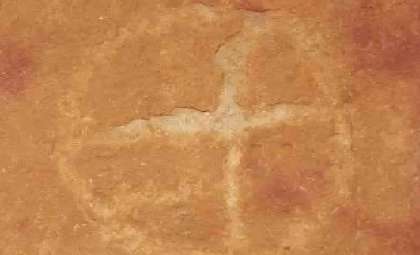
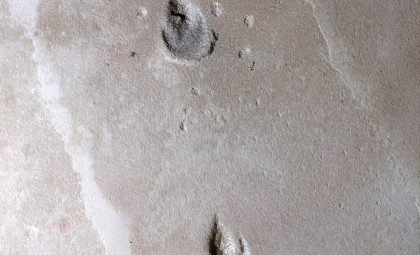
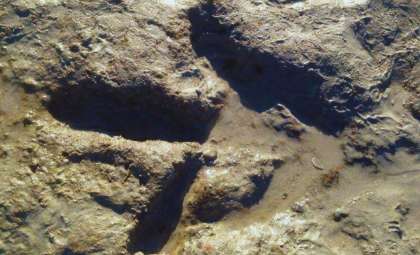
Unearthed in Brazil, a series of 130-million-year-old footprints may belong to the most sizable mammal discovered from the dinosaur period. These tracks, located in the Botucatu Formation, indicate an animal about 1.55 meters in length, nearly double the size of any documented Cretaceous mammal, possibly large enough to prey on juvenile dinosaurs.
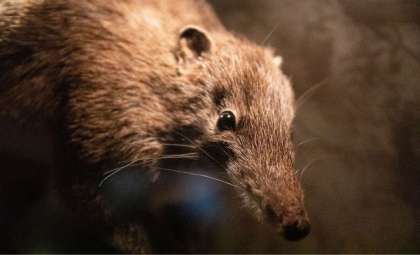
For years, the prevailing view of early mammals has depicted them as small, shrew-like creatures scurrying to avoid predation by dinosaurs. Fossilized bones from Mesozoic mammals are scarce, particularly in the Southern Hemisphere, leaving scientists to often rely on incomplete remains.
This new finding, detailed in the Journal of South American Earth Sciences, contributes to the limited yet expanding evidence that mammals of considerable size coexisted with dinosaurs in certain habitats. Unlike skeletal remains, this discovery hinges entirely on footprints, which researchers claim reveal surprisingly intricate details.

Large Footprints Indicate Unusually Big Mammal
The footprints are notably large: the largest prints measure 11.4 centimeters long by 13.4 centimeters wide, with an average stride of 40 centimeters. The dimensions and shape led Dr. Pedro Buck and his team to identify these as mammalian, rather than dinosaurian. The experts described the preservation conditions at the site:
“In the Botucatu Formation, most vertebrate tracks are preserved under conditions of low substrate cohesion, which commonly results in simplified morphologies and partial loss of fine anatomical detail.”
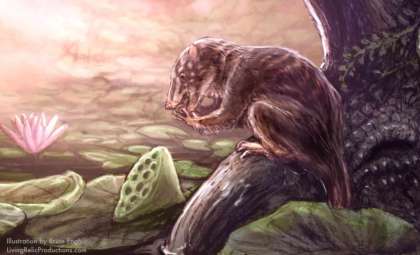
The researchers attributed the footprints to the Chelichnopodidae family but refrained from naming a new species due to the absence of accompanying bones. By comparing with species whose skeletons and tracks are known, they estimate the animal was about twice the size of the largest Cretaceous mammals found to date, resembling a large dog or a mountain lion more than a tiny shrew.
“The trackmaker is considerably larger than any mammalian species currently known from either skeletal remains or fossil tracks,” said Dr. Buck. “We have a game changer here.”
Desert Environment Enabled Mammal Growth
During that era, the Botucatu Formation was part of an expansive desert, distant from any ocean, later divided by the breakup of Gondwana into parts of South America and an isolated section of Africa. This isn’t the first discovery of large mammal tracks from this formation: earlier finds named Aracoaraichnium leonardii and Brasilichnium anaiti in 2017 were the size of medium-sized dogs or large cats.
In an interview with Science, Dr. Pedro Buck suggested that larger dinosaurs may have been absent from this desert biome for reasons still unclear, opening niches for mammals to evolve larger sizes.

Challenges of Finding Skeletal Evidence
While verifying the footprints with skeletal fossils remains a key goal, the chances are slim. Dr. Hermínio Ismael de Araújo-Júnior, co-author of the research, explained that the absence of bones is itself significant:
“No mammaliaform body fossils are currently known from Jurassic or Early Cretaceous rocks in Brazil, and the Early Cretaceous skeletal record of mammaliaforms in Gondwana as a whole is extremely scarce. This makes the Botucatu tracks particularly important: They reveal animals that are simply absent from the Brazilian skeletal fossil record.”

De Araújo-Júnior noted that future fossil discoveries might emerge from deposits formed in environments more conducive to preserving bones than desert sands:
“The best prospects may be deposits representing more favorable local environments within, or temporally close to, this ecosystem, where carcasses had a greater chance of being buried and preserved.”
He also advised paleontologists to remain open to reinterpreting previously found large tracks or fragmentary fossils, which might have been overlooked due to biases about Mesozoic mammal sizes. As he explained:
“The traditional expectation that Mesozoic mammaliaforms were predominantly very small could potentially influence how unusually large tracks or fragmentary fossils are interpreted.”
Although the footprints cannot definitively reveal the animal’s diet, the authors propose it was likely an omnivore, capable of preying on young or small dinosaurs, other mammals, invertebrates, and various opportunistic food sources.
- Categories:
- Science

0 comments
Sign in to Comment