

Lying beneath the surface of the Bay of Naples, the ruins of Puteoli—once a vital hub for commerce in the Roman Empire—are gradually being uncovered. Archaeologists are investigating submerged harbors, workshops, and storage facilities preserved underwater for nearly two millennia.
Situated just three to five metres underwater near modern Pozzuoli, this ancient port offers unprecedented insight into the bustling activities of a city that once linked Rome with the wider Mediterranean world.
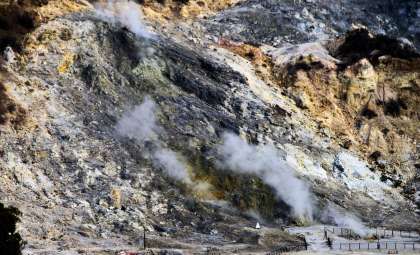
The submerged state of Puteoli is attributed to the phenomenon of bradyseism, a volcanic process in the Campi Flegrei region that causes slow changes in ground elevation. Over time, this caused the shoreline to sink, submerging almost two kilometers of the historic harbor district.

Uncovering a Roman Harbour Preserved Underwater
A comprehensive archaeological initiative spanning 2021 to 2027 aims to chart the underwater remains of Puteoli. This project is spearheaded by underwater archaeologist Dr. Michele Stefanile from the Italian Institute for Maritime Archaeology and Underwater Structures.
As reported by Ancient Rome Live, the research combines advanced techniques such as remotely operated vehicles (ROVs), photogrammetry, 3D modelling, and GIS mapping to reconstruct the ancient harbor’s layout. During exploration dives approaching an hour, Ancient Rome Live director Darius Arya and Dr. Stefanile examined areas including a workshop for carving marble and walls with preserved wooden components.

These discoveries uncover the port’s vast economic functions. Beyond the transport of trade ships and cargo, there existed a sophisticated network of storage buildings, workshops, and working spaces that energized the economy of Imperial Rome.
Rediscovery of a Sunken Nabataean Temple
Among the most unexpected finds is the submerged Temple of the Nabataeans, believed to be the sole Nabataean temple identified outside the ancient Nabataean Kingdom.
Though originally documented during 1980s surveys, the temple remained understudied due to funding limits. Nearly two decades of searching culminated in Stefanile’s team relocating it in the initial survey phase of 2021.

According to research sources, the temple’s structure is exceptionally well-preserved, shielded by layers of Roman concrete dating back to the 2nd century AD. These concrete layers were established after Emperor Trajan annexed the Nabataean territories.
The Submerged Port That Supplied an Empire
Scholars are also examining underwater granaries within the vicus Annianus, where Egyptian grain was stored before distribution to Roman markets and citizens. The site aligns with information from ancient documents, including the wax tablets of the Sulpicii, a family of bankers from Puteoli.
These records reference loans tied to grain storage in this location. As detailed by Dr. Stefanile, the preserved wooden frameworks and interior fittings can provide fresh insights about the organisation of Roman granaries. “
This may be the only site in the world where we can observe the internal organisation of a Roman granary in such detail,” he said.

For Darius Arya, this historic city has long been overlooked. He called it “the port city of Rome and the empire” before the establishment of Portus at Ostia, emphasizing that:
“The tragedy is that so much of it has been lost to the sea, claimed gradually by bradyseism – the slow volcanic ground movement that has been swallowing the Bay of Pozzuoli’s coastline for centuries.”
With its conserved harbor infrastructure, industrial zones, and forgotten shrines, the submerged ancient city portrays a distinct view of Rome—one shaped by commerce, travel, and Mediterranean connections.
- Categories:
- Science










0 comments
Sign in to Comment