

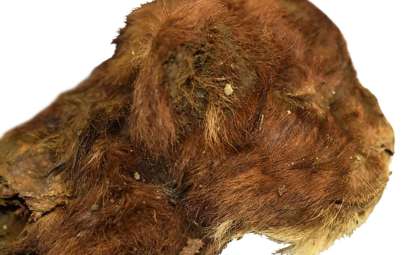
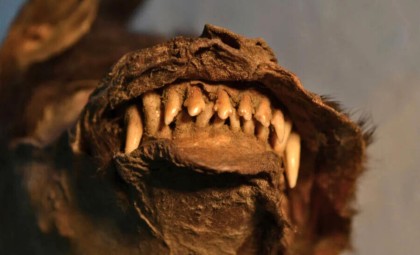
A dark brown coat still envelops the head and forelimbs of a saber-toothed cat kitten that lived tens of millennia ago. Distinct rows of whiskers are clearly visible above its upper lip, and the pads with sharply curved claws on its front paws remain well-preserved after being frozen in the Siberian permafrost, a terrain that remains frozen for extended periods.
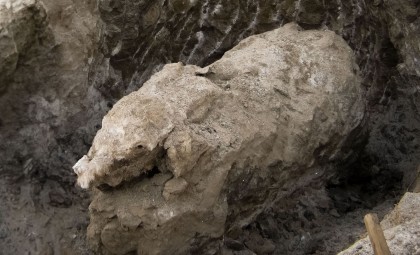
Discovered close to the Badyarikha River in Yakutia, northeastern Russia, much of the cub’s head, chest, and front limbs have survived, along with portions of its hindquarters trapped in ice.
Radiocarbon dating conducted on the cub’s fur and other organic samples revealed an age of 31,808±367 radiocarbon years, which, when calibrated, places the animal’s age at roughly 35,471 to 37,019 years.

A recent article published in 2024 in Scientific Reports, authored by Alexey V. Lopatin and team, identifies the creature as a juvenile Homotherium latidens—an extinct saber-toothed feline species—and estimates the cub was only about three weeks old at its time of death.

The exceptional state of preservation provides scientists with a rare opportunity, offering more than just bone and tooth data. It allows exploration of soft tissues such as skin, muscle, whiskers, and paws, which usually degrade and are missing from fossil records.
Ashley Reynolds, a paleontologist at the Canadian Museum of Nature uninvolved in this research, shared with National Geographic her excitement: “I was over-the-moon excited to see such an incredible specimen.” While Siberia has yielded frozen herbivores like mammoths, discoveries of well-preserved predators remain extraordinarily uncommon.
Unique Features of a Three-Week-Old Predator
Scientists compared this juvenile Homotherium’s anatomy with that of a similarly aged lion cub using detailed anatomical observations and high-resolution CT scans. They noted marked differences even at such an early stage of maturity.
Unlike a lion cub, Homotherium had smaller ears positioned lower on the skull and a relatively larger mouth opening. The cub also exhibited a notably extended upper lip—particularly significant given that adult Homotherium were characterized by long upper jaw canines.

The dark brown coloration of the fur came as a surprise to researchers. Lopatin mentioned to National Geographic, “The uniform dark brown color of the mummy fur turned out to be completely unexpected.”
However, paleontologist Margaret Lewis cautioned that icy preservation often alters coloration postmortem, so the present fur shade may differ from its original appearance.
Enhanced Limbs and Broad Front Paws
Notable distinctions were evident in the limb proportions of the cub.
Despite the similar overall size, its front legs were 18 to 23 percent longer than those of the comparison lion cub, and the mouth opening was around 15 percent wider.
Previous adult Homotherium fossils indicated long limbs and robust neck muscles; the frozen cub demonstrates that these characteristics developed quite early in life.
Lewis told National Geographic, “The cub had the enlarged neck muscles typical of adults, along with the long, powerful forelimbs seen in mature Homotherium.”
Investigation of the paws revealed subtleties that skeletal remains alone cannot provide. The front paws of the Homotherium cub were broad and rounded, nearly as wide as they were long. In contrast, lion cub paws appeared narrower and more elongated.

Additionally, researchers observed differences in the soft pads beneath the paws; the Homotherium cub lacked the carpal pad found on modern cats’ front legs.
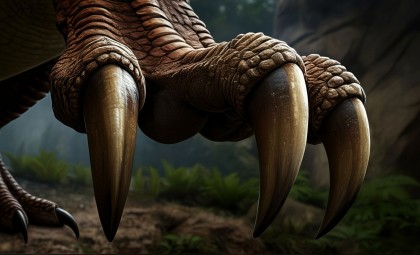
All front claws were intact—sharp, strongly curved, and slightly flattened laterally, resembling those of lions in overall form.
Investigators propose that the broad paws, reduced ear size, and other traits may have been adaptations to cold, snowy habitats.
Remaining Mysteries
The specimen sheds light on features that skeletal remains alone cannot reveal, confirming that young Homotherium possessed a powerful neck, long forelimbs, and wide paws.
Still, uncertainties remain. Since the cub hadn’t developed its characteristic adult saber teeth, scientists are unsure if those fangs would have been visible when the adult’s mouth was closed.
According to Smithsonian Magazine, researchers are eager to examine the animal’s DNA, which they believe can still be extracted.
“DNA can be extracted, and this is one of the next stages of our research,” Lopatin revealed.
Currently, the Badyarikha cub offers an extraordinarily well-preserved glimpse into a creature typically known only through its bones and teeth. Its whiskers, paw pads, and claws remained frozen in Siberia for nearly 36,000 years.
- Categories:
- Science


0 comments
Sign in to Comment