

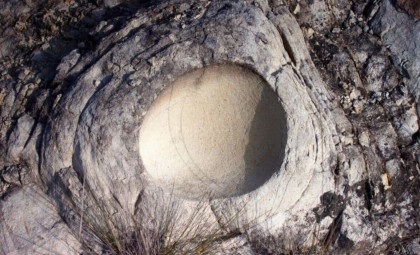
Scientists in Argentina have unveiled a remarkably preserved 70-million-year-old dinosaur egg unearthed in Patagonia, marking a potential first in South America—a nearly complete egg from a carnivorous dinosaur. The fossil's value could increase if it is verified that an embryo remains inside.
The egg was located within the Allen Formation in the Río Negro Province during Cretaceous Expedition I, a project broadcasted live online. Led by paleontologists Federico Agnolín and Matías Motta, the team kept the discovery confidential until revealing it during the stream, giving viewers direct access to the find.
Beyond the fossil's intrinsic significance, dinosaur eggs provide insights unavailable from skeletons, such as reproductive strategies, nesting behavior, and parental care. The Laboratory of Comparative Anatomy and Evolution of Vertebrates (LACEV) at the Argentine Museum of Natural Sciences reported previous significant finds during the expedition, including fossils of duck-billed dinosaurs, a sauropod, and small Mesozoic mammals.

An Exceptionally Intact Fossil
The egg’s outstanding preservation immediately attracted attention. Although exposed to natural forces for millions of years, its shell remains mostly white. Federico Agnolín admitted his initial disbelief that the object was fossilized.
Scientists suggest this specimen could be the most intact and well-preserved meat-eating dinosaur egg ever found. It might also come from a theropod species unknown to science. Its elongated form contrasts with the rounder, thicker eggs typical of long-necked sauropods, resembling the shape of modern bird eggs—linking it to the theropod clade, which includes predatory dinosaurs and avian ancestors.

The discovery followed a fruitful expedition that had already uncovered fossils likely belonging to two types of duck-billed dinosaurs, a sauropod, and small prehistoric mammals.
Determining the Species Behind the Egg
One of the main puzzles rests in identifying which dinosaur produced the egg. Scientists first suspected it belonged to Bonapartenykus, a small carnivorous theropod from the Late Cretaceous native to the area. However, comparisons with earlier-discovered shell fragments ruled out this option.
The egg’s surface patterns did not align, indicating a carnivorous dinosaur unlike previously documented species. Agnolín stated the egg may originate from a species whose adult skeleton remains undiscovered.
“We believe we’re looking at another kind of carnivorous dinosaur — perhaps one whose adult form is not yet known,” he added, confirming its identity will require a detailed study of the shell’s microscopic structure.

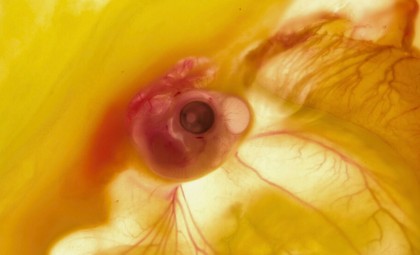
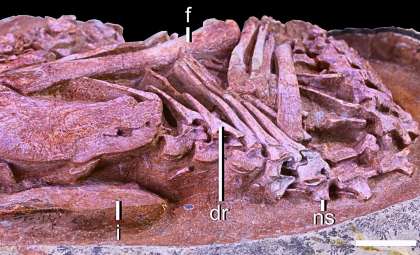
The researchers intend to use micro-CT scanning to explore the fossil noninvasively, potentially revealing internal structures and whether an embryo is preserved inside.
Finding an embryo inside would be an extraordinary rarity. Although dinosaur embryos have been found globally, Argentina’s prior discoveries have been limited to sauropods, not predatory theropods. Agnolín remains optimistic, yet realistic, about the chances of uncovering embryo remains.
Insights from a Dinosaur Nest
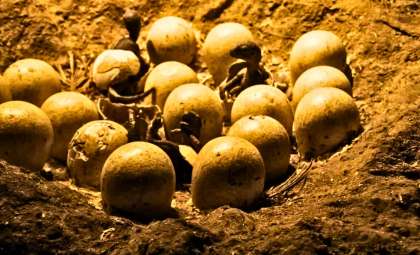
The egg was recovered alongside fragments of other eggshells and eroded nest components. Nearby, the team also found remains of Rocasaurus muniozi, a titanosaur allied with bird-like respiratory adaptations.
If verified as a nest, this site would represent South America’s first recognized carnivorous dinosaur nesting ground, offering rare data about predatory dinosaur reproductive behavior before the close of the Cretaceous Period.
“A skeleton doesn’t tell you any of that,” he adds. “It doesn’t reveal whether the animal cared for its offspring, or whether it was social or solitary. A nest, on the other hand, does. And that’s what’s fascinating. It lets us glimpse the behavior of animals that lived 70 million years ago. That’s the true value of this discovery,” stated Agnolín.
Theropods play a central role in the evolution linking dinosaurs to birds, which build nests, incubate eggs, and nurture their young. Examining ancient theropod eggs and nesting sites could shed light on the origins of these behaviors over millions of years.
- Categories:
- Science







0 comments
Sign in to Comment