

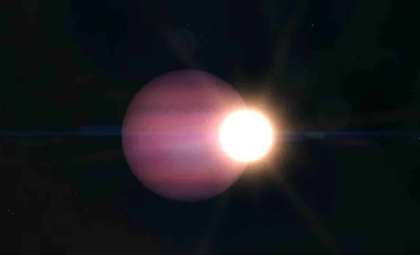
Scientists have uncovered a massive Jupiter-sized body orbiting a brown dwarf within the CD-35 2722 stellar neighborhood, marking a strong candidate for the first confirmed exosatellite located outside our Solar System. Unlike moons in our planetary system that circle planets, this object revolves around a brown dwarf, which itself orbits a host star.
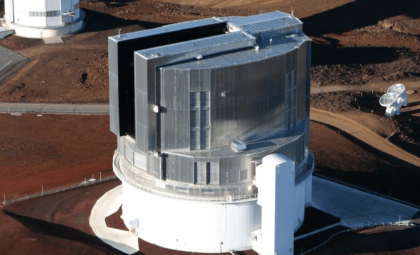
This breakthrough came from observations using the European Southern Observatory’s Very Large Telescope (ESO’s VLT). By examining the gravitational influence the mysterious body exerts on the brown dwarf, astronomers have identified a system that challenges classic conceptions of moons and planets.
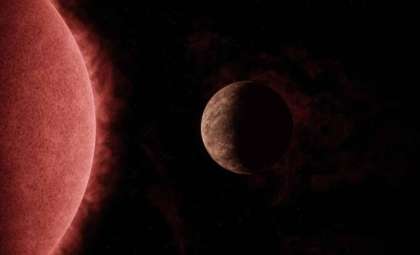
The CD-35 2722 system contains a star approximately half the mass of our Sun, orbited by a brown dwarf. The newly detected companion orbits this brown dwarf. Brown dwarfs sit in a borderline category; too substantial to be planets, yet not massive enough to ignite hydrogen fusion and become stars.

Presented in Nature, the research was spearheaded by Kevin Hoy, a Chile-based ESO student linked to Universidad Diego Portales and the Millennium Nucleus of Young Exoplanets and their Moons (YEMS). The team describes this system as “exceptionally unusual” because its setup deviates considerably from Solar System norms.
A Massive Companion That Defies Easy Classification
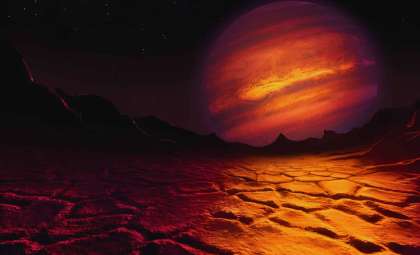
With a mass comparable to Jupiter’s and orbiting a brown dwarf exceeding 30 times that mass, this exosatellite blurs conventional boundaries defining moons and planets.
Kevin Hoy pointed out that while the object's heft categorizes it as a planet, its orbital path around a brown dwarf — instead of a star — complicates this. Hence, the term moon is used to describe its status as a companion within the system, even though it differs from known Solar System moons.

The team refers to this entity as an exosatellite, a natural satellite external to our planetary arrangement. This finding emphasizes the diversity of cosmic systems and how they often defy traditional classification frameworks.
Alice Zurlo, director of YEMS and an astrophysicist at Universidad Diego Portales, described the companion as a gargantuan gaseous planet orbiting a notably massive host. She explained that:
“We have a clear delineation between the planets and the Sun in the Solar System, so defining things like moons is simple. In the CD-35 2722 system, where we are blurring the lines between stars, planets, and moons, the whole thing becomes more complicated to describe.”
Detecting the Brown Dwarf's Subtle Shift Reveals Its Companion
Discovery hinged on identifying faint wobbles in the brown dwarf’s motion, tracked using the CRIRES+ spectrograph at ESO’s Very Large Telescope. The team employed the radial velocity technique, which detects celestial objects by observing their gravitational influence on one another.
This approach, historically pivotal in unveiling numerous exoplanets around stars similar to the Sun, was instrumental in recognizing slight deviations in the brown dwarf’s trajectory, interpreted as the signature of the Jupiter-scale exosatellite.

The published study highlights this signature as strong evidence for an exosatellite, a milestone after extensive searches for moons outside our system. Although astronomers have identified over 6,000 exoplanets, definitive detections of exomoons remain elusive.
Earlier work in the HD 206893 system, led by Quentin Kral using the ESO’s Very Large Telescope Interferometer, hinted at a potential satellite. The findings, while promising, did not confirm an exomoon unequivocally.
The Next Frontier in Exomoon Exploration
A bona fide satellite detection outside the Solar System will revolutionize understanding of satellite formation and evolution in diverse cosmic environments. The authors note that systems like CD-35 2722 expose the challenges in applying Solar System-based definitions to radically different celestial architectures.
The upcoming Extremely Large Telescope (ELT), outfitted with a massive 39-meter mirror and cutting-edge tools, promises to enhance the hunt for smaller moons around distant worlds, broadening insight into planetary systems and satellite occurrences unlike anything seen in our own region of space.
- Categories:
- Space

0 comments
Sign in to Comment