

A supermassive black hole has been spotted lurking approximately 30,000 light-years away from the core of its host galaxy—marking the first discovery of an inactive black hole at such a distant offset from a galactic nucleus. This black hole remained hidden until it disrupted a nearby star, generating a brief burst of light that an AI-driven sky survey detected last November. The results were published on July 27, 2026, in The Astrophysical Journal Letters.
The breakthrough was achieved by a research group at the University of Maryland led by Robert David Stein, a Neil Gehrels Prize Postdoctoral Fellow with the Joint Space-Science Institute, a collaboration involving UMD’s Astronomy and Physics departments and NASA’s Goddard Space Flight Center.
“This finding is unprecedented. Until now, we assumed supermassive black holes inhabited galaxy centers,” said co-author Suvi Gezari, associate professor of astronomy at UMD. “Our discovery suggests many more wandering black holes exist, which will aid in understanding galaxy and black hole co-evolution over cosmic time.”

Artificial Intelligence Pinpoints Star-Shredding Event Months After Program Debut
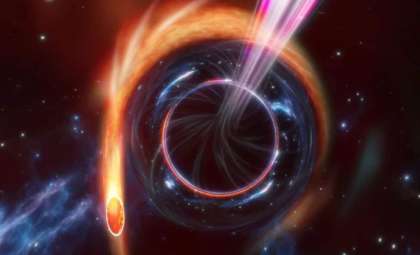
The black hole, designated TDE 2025abcr, would have gone unnoticed without its dramatic activity. Being dormant, it emits no significant light or radiation, eluding typical detection methods. The team identified it when it caused a tidal disruption event—where the black hole’s immense gravitational forces tore apart a passing star, releasing a luminous flare.
Researchers utilized the Zwicky Transient Facility (ZTF), which scans the entire northern sky bi-daily using twin telescopes at Palomar Observatory in California. Each night, ZTF captures hundreds of thousands of transient phenomena, an overwhelming amount to review manually.

To manage the data flood, the team developed an AI tool trained to detect the unique light pattern of tidal disruption events. Unlike traditional searches focused near galactic cores, this algorithm scans the entire sky.
Launched in August 2025, the system flagged this exceptional event just three months later.
“I recall that discovery moment vividly. It was a Saturday, and everyone was excitedly communicating. We immediately mobilized other instruments to gather more data,” Stein said. “We didn’t expect success so soon, so finding one quickly was remarkable.”
A Massive Black Hole Without a Visible Surrounding Galaxy
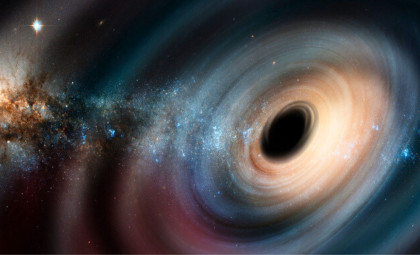
This black hole lies roughly 9.3 kiloparsecs (about 30,000 light-years) from its galaxy’s center and has a mass similar to the Milky Way’s central black hole. Surprisingly, there is no evident galaxy around it.
“Having such a massive black hole isolated from a galaxy is quite astonishing,” noted co-author and UMD Astronomy Professor Sylvain Veilleux. “We’d expect it to be surrounded by a Milky Way-sized system, but that’s not the case here.”

The scientists propose two main explanations, both linked to ancient galactic mergers. One theory is that a large galaxy swallowed a smaller companion, stripping it of nearly all its stars over time and leaving behind only the compact core and its black hole. The other involves a complex three-body interaction: two black holes orbiting each other at a galaxy’s center encounter a third black hole arriving via a merger, ejecting the smallest black hole outward through chaotic gravitational forces.
Further monitoring of the tidal disruption event may shed light on which scenario is correct.
Dormant Black Holes Are Common; Some Might Roam Freely
Most black holes, including our Milky Way’s central one, are inactive, making them difficult to detect. Whether our galaxy harbors wandering black holes beyond its central region remains unknown. Stein reassured, “Encountering one of these wandering black holes is very unlikely within our lifetime.”
The team continues to search for more rogue black holes, aiming to better understand galaxy formation and the population of black holes traveling through space. This discovery showcases how combining traditional sky surveys with machine learning offers a cost-effective means to uncover such elusive objects.
“This is incredibly exciting,” Gezari said. “It’s a powerful example of how AI is unlocking new frontiers in astronomy.”
- Categories:
- Space




0 comments
Sign in to Comment