

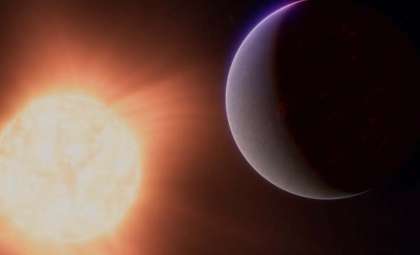
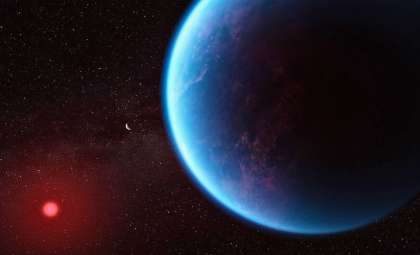
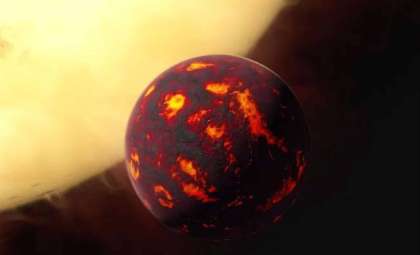
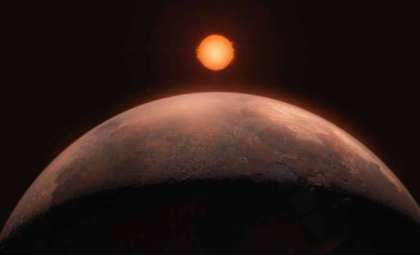
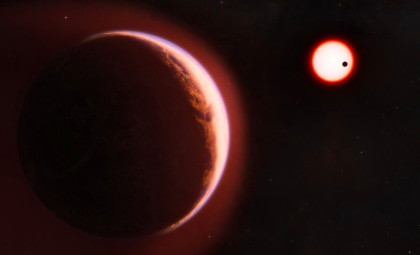
Scientists have unveiled GJ 523b, a rocky exoplanet boasting a mass approximately 23.5 times that of Earth. Contrary to predictions from planetary formation theories, this world has not evolved into a gas giant despite surpassing a critical mass threshold, remaining a dense terrestrial planet instead.
GJ 523b measures roughly 2.55 times the diameter of Earth but maintains a surprisingly high density, indicating it possesses a thinner atmosphere than typically anticipated for a planet of such magnitude.
The planet was initially flagged as a candidate by NASA’s Transiting Exoplanet Survey Satellite (TESS), which locates exoplanets by detecting small drops in stellar brightness caused when a planet transits its star. Subsequent observations enabled astronomers to accurately determine its mass, size, and density.

A team at the University of Wisconsin–Madison employed the WIYN 3.5-meter Telescope at Kitt Peak National Observatory in Arizona to gauge the gravitational influence of GJ 523b on its parent star. Their measurements showed the planet has a density near 126.82 grams per cubic inch and orbits its star every 17.75 days. The system's age is estimated at close to 170 million years.
An Exoplanet Straddling the Line Between Rocky and Gas Worlds
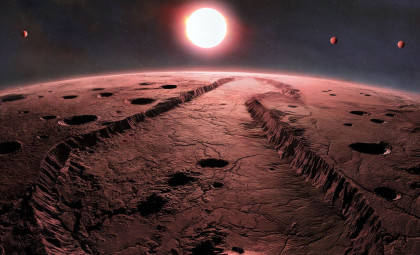
GJ 523b occupies a unique niche in the range of known exoplanets. Although significantly larger than typical rocky planets like Earth or Mercury, it lacks the dense gaseous envelope expected for planets of its size. Current planet formation models suggest that planets form solid cores from rock and metal and subsequently attract hydrogen and helium from the disks surrounding young stars as they grow.
What puzzles scientists is GJ 523b’s mass, surpassing the approximate 20 Earth-mass threshold where gas giants like Jupiter and Saturn are believed to have rapidly accreted thick atmospheres in our solar system. Yet, this planet remains primarily rocky rather than gas-dominated.
“This isn’t what we expected at all,” said Max Kroft, lead author of the study, in a statement from the University of Wisconsin–Madison. He noted that: “Dense planets like this aren’t uncommon, but they’re usually small rocky planets similar to Earth or Mercury. This planet is two and a half times bigger than the Earth.”

Exploring the Planet’s Unique Nature
The findings, outlined in a paper on arXiv, drive scientists to investigate why GJ 523b avoided the gas giant trajectory common in massive planets. One theory posits that the planet initially possessed a thick atmosphere that was stripped away over time, possibly due to exposure to intense stellar radiation from its youthful host star.
Alternatively, the research suggests a catastrophic planetary collision might explain GJ 523b’s characteristics. This scenario involves two planetary bodies merging after an impact, producing a substantial rocky planet but ejecting much of their gaseous layers into space.

These remain hypotheses, as the peculiar traits of GJ 523b cannot be fully explained by a single example. Further observations of similar planets are necessary to determine if GJ 523b represents an anomaly or a category of rocky mega-planets.
The Impact of More Rocky 'Mega-Earths' on Planet Formation Theories
The term “mega-Earth” is informally used to describe extremely massive rocky planets, though it lacks a strict scientific definition. The addition of GJ 523b expands the small sample of such unusual planets that challenge traditional classifications.
Uncovering additional worlds with comparable properties would aid scientists in identifying patterns in planetary development. As Kroft emphasized:
“It’s hard to infer things about planet formation in general from a sample size of one.” He added that studying around 20 or 30 such planets could reveal trends that are impossible to see from a single discovery.
GJ 523b stands at a pivotal point, having crossed the mass boundary where gas giant development is expected but continuing as a rocky planet instead. Understanding its formation may broaden our knowledge of the diversity of planetary outcomes throughout the cosmos.
- Categories:
- Space


0 comments
Sign in to Comment