

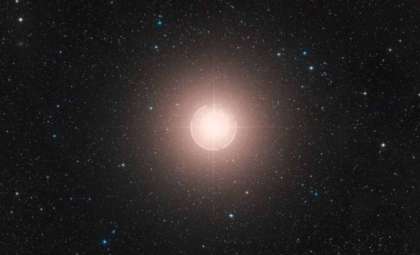
Advanced imaging of Betelgeuse uncovers an increasingly irregular and asymmetric atmosphere just above its surface, exhibiting a consistent pattern possibly influenced by a small nearby stellar companion. These insights, to be published in Astronomy & Astrophysics, offer an exceptional glimpse into the forces sculpting this iconic red supergiant as it ejects material into its cosmic surroundings.
ALMA Revisits Betelgeuse Post-Great Dimming
Researchers gained crucial perspective by comparing fresh data with earlier observations of Betelgeuse captured before a significant dimming event drastically lowered its brightness by approximately 2.5 times. The Atacama Large Millimeter/submillimeter Array (ALMA) last focused on the star in 2015, preceding the notable Great Dimming of 2020. This event sparked curiosity about the conditions near the star’s visible surface and extending layers.
Under the leadership of Bill Dent from the University of Manchester, the team’s study, appearing in Astronomy & Astrophysics, uses ALMA’s capabilities to compare the current state of Betelgeuse’s outer atmosphere to its state pre-dimming. As Dent states, “Betelgeuse is one of the closest red supergiants—stars that are destined to explode as supernovae, yet meanwhile enrich interstellar space through powerful stellar winds.” These observations don’t suggest an imminent explosion but rather provide a unique window into the processes shaping the star’s atmosphere and its impactful influence on the interstellar medium.


ALMA Captures Detailed Atmospheric Complexity
This research leverages ALMA’s sensitivity to millimeter and submillimeter wavelengths and its unmatched spatial resolution. Situated in Chile’s Atacama Desert, ALMA’s 66 radio antennas exploit the dry climate to study wavelengths between about 0.6 and 1.4 millimeters, probing gas slightly above Betelgeuse’s visible surface. This approach reveals the intricate atmosphere rather than just the star’s photosphere visible in light.
Dent’s group utilized ALMA’s longest baselines—spanning the greatest distances between antennas—to push resolution limits. Clear weather and refined processing further sharpened the data. Dent explains, “We resolved ionized and molecular gas structures as fine as 7 milliarcseconds—comparable to distinguishing features 13 meters wide on the moon’s surface.” This precision exposed a highly irregular atmosphere with distinct temperature and brightness variations, contradicting any notion of a smooth, uniform outer layer.
Betelgeuse’s Atmosphere Grows Spotty and Uneven
New data compared to 2015 images reveal Betelgeuse’s atmosphere has become distinctly more spotty and asymmetric, featuring isolated hotspots that stand out dramatically. Some regions are roughly 800 degrees Celsius hotter than adjacent areas, highlighting intense local variation. ALMA also identified a landscape dominated by enormous convective cells—massive circulating patterns where heated gas rises, spreads, cools, then sinks back, transferring energy through the star’s layers. Unlike smaller, numerous convective cells seen on the Sun, Betelgeuse only hosts a handful of vastly larger cells that sculpt its atmospheric appearance.
One hot spot is especially notable because it appears to have endured or reappeared in the same location over an extended period.
“The brightest hot spot was also seen in the 2015 data, suggesting that convective cells are actually rather persistent,” says Dent. “It also confirmed there is a preferential alignment of the hot spots along a particular direction.”
This alignment suggests the atmospheric structures may be influenced by more than just random convection, hinting at an underlying organizing mechanism.
A Nearby Small Companion Might Be Shaping the Atmospheric Pattern
The directional alignment of Betelgeuse’s hot spots gains significance in light of evidence for a diminutive companion star orbiting in close proximity. Detected in July 2026, this companion could be a key factor in the star’s complex atmospheric behavior. Although the current ALMA data don’t conclusively link the companion to the hot spot arrangement, the geometric correlation invites further investigation. Should the companion’s orbit align with Betelgeuse’s equatorial plane, it’s possible the bright spots concentrate near the star’s poles.
In such a framework, stellar spin, convection, and orbital dynamics might collectively shape the preferred directional pattern observed. Dent emphasizes this as a provocative hypothesis rather than a confirmed cause: “This suggests that the brightest, most enduring hot spots could reside near the poles, where convection might be stronger and more stable,” he notes. Confirming this theory will depend on ongoing monitoring that can correlate atmospheric hotspots with the companion’s orbital movement. Persistent alignment through time would strengthen the case for a structured, large-scale atmospheric geometry in Betelgeuse’s otherwise tumultuous environment.
Hot Spot Patterns Offer Clues to How Red Supergiants Shed Mass
These findings extend beyond Betelgeuse’s appearance, addressing fundamental questions about mass loss in red supergiants. These stars lose mass through powerful winds before their eventual supernova, yet the mechanisms enabling this mass ejection remain incompletely understood. Betelgeuse serves as a rare laboratory permitting direct observation at high resolution.
Large convective cells drive both energy and material flux through the atmosphere, while asymmetric, localized heating may direct how gas escapes into outer layers. The presence of a small companion star introduces additional complexity, potentially organizing or disrupting these processes. Thus, ALMA images not only update our view following the 2020 dimming but set a detailed baseline for future studies. Monitoring whether hotspots remain static, move, vanish, or evolve with the companion’s orbit could reveal if the observed alignment reflects stable atmospheric architecture or transient convection phenomena.
- Categories:
- Astronomy




0 comments
Sign in to Comment