

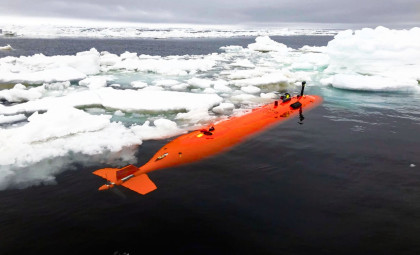
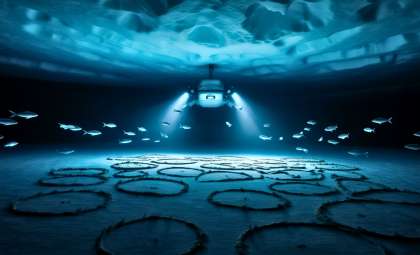
Beneath thick Antarctic ice, an eye-catching orange robot submarine ventured where conventional navigation systems like ships, GPS, and satellites could not reach. The autonomous submersible called Ran, measuring seven meters in length, followed predetermined paths beneath the Dotson Ice Shelf independently, without real-time communication with the surface vessel. Once it slipped beneath the ice shelf, the research team awaited its resurfacing.
During the 2022 expedition, Ran made extensive explorations across the cavity below the Dotson Ice Shelf in West Antarctica. It covered over 1,000 kilometers and traversed depths of up to 17 kilometers under the shelf, deploying upward-facing sonar and collecting data on currents, temperature, and salinity. Some missions lasted longer than 24 hours, operating beneath layers of ice ranging from 200 to 500 meters thick.

Led by Anna Wåhlin, an oceanography professor at the University of Gothenburg, scientists part of the International Thwaites Glacier Collaboration aimed to observe the ice shelf’s underside firsthand rather than infer its shape solely from surface data. Returning in January 2024 for follow-up surveys, Ran managed only one dive before unexpectedly failing to reappear.

Sonar Maps Reveal Ice Features Invisible from Above
Data collected in 2022 uncovered underwater ice structures beyond satellite observation capabilities. Using multibeam sonar, Ran created six detailed maps that spanned roughly 140 square kilometers of the ice base, revealing terraces, channels, fissures, smooth eroded surfaces, and other novel formations. The Science Advances paper headed by Wåhlin identified distinctly different melting behaviors occurring within various sections of the ice shelf.

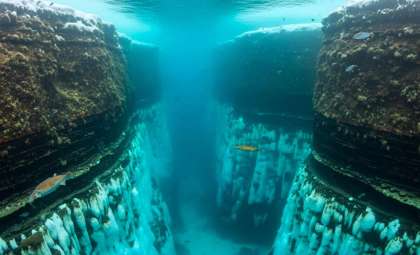
The easterly and central parts featured flat terraces between 200 and 2,000 meters wide, bordered by steep edges of about 0.5 to 5 meters in height. Some formed multi-tiered terraces with reliefs ranging from 5 to 40 meters. These structures were associated with slower melting rates, convective currents, and sporadic injections of warmer waters.
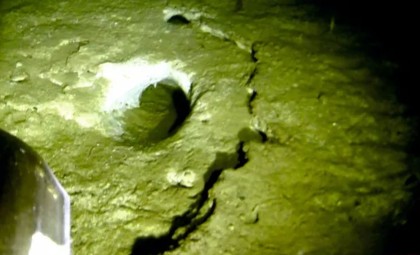
In contrast, the western zone displayed a smoother and more intensively eroded ice base, punctuated by clusters of teardrop-shaped indentations undetectable from the surface. The largest measured an average width of 68 meters, spanning anywhere from 20 to 170 meters.
Swift Currents Sculpt the Western Ice Shelf Margin
Measurements beneath the Dotson Ice Shelf recorded gentle currents of approximately 0.01 to 0.04 meters per second in the central and eastern sectors. On the western side, however, meltwater-driven flows moved much faster, reaching up to 0.25 meters per second. This dynamic region exhibited basal melting rates as high as 15 meters annually.
Wåhlin’s group attributed the rapid melting to a combination of shear-generated turbulence and inflows of warm, modified Circumpolar Deep Water. The uniquely shaped teardrop indentations appeared exclusively within this high-speed flow zone. The team theorized that frictional forces and Earth’s rotation within a 5- to 15-meter thick boundary layer influenced the water’s movement, giving rise to these asymmetric forms.

Ran also detected full-thickness cracks in the ice, some of which showed signs of widening and basal erosion. Satellite data cited in the publication indicated that some of the oldest cracks first appeared at the surface during the 1990s, while newer fractures were only a few years old when mapped.
Independent Robot Confirms Complex Water Movements Beneath Dotson
Another research effort reported in a 2025 Ocean Science article examined water dynamics beneath the Dotson Ice Shelf. Maren Elisabeth Richter and collaborators from the University of East Anglia employed the AutoSub Long Range vehicle, collecting over 100 kilometers of underwater track data, including current speeds and turbulent mixing rates. Their findings revealed sharp spatial variability in mixing instead of a uniform distribution.
Background turbulence dissipation measured about 10^-10 watts per kilogram, with localized hotspots reaching 10^-8 watts per kilogram. Mean vertical heat fluxes were approximately 0.1 watts per square meter, peaking at 52 W/m². Enhanced mixing correlated with acceleration zones over slopes, areas of increased vertical shear, and steep seabed topography.

Adding to the broader context of West Antarctic ice changes, the study referenced the 2019 mass-balance study led by Eric Rignot. It reported that Dotson contributed roughly 0.6 millimeters to global sea level rise from 1979 to 2017. The analysis underscored how warm deep ocean waters infiltrate the cavity, reaching critical grounding lines beneath the ice.
Ran’s Disappearance Prevents Follow-up Mapping Efforts
The opportunity to update and compare ice shelf mappings vanished in February 2024. Ran failed to surface during its final scheduled dive beneath Dotson. Despite extensive search operations involving acoustic sensors, helicopters, and drones, the autonomous submarine was not located and is presumed lost beneath the ice.
This unfortunate incident leaves the comprehensive 2022 survey as the most detailed account of the ice shelf’s submerged landscape. The study demonstrated how melting caused by convection, turbulence, warm water intrusions, fractures, and boundary layer flows creates diverse physical patterns on a single ice shelf, with explorations extending 17 kilometers into the Dotson cavity.
- Categories:
- Science


0 comments
Sign in to Comment