

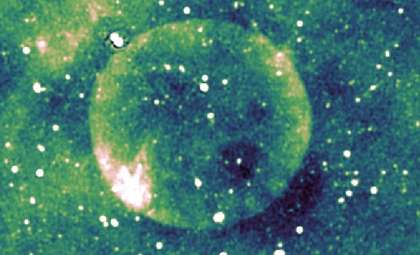
New findings from astronomers reveal a highly energetic pulsar wind nebula concealed inside the CTA 1 supernova remnant, showcasing a compact structure that drives particles to extraordinary energies. NASA’s Chandra X-ray Observatory delivered unprecedented insight into the dynamic between a young pulsar and the expanding debris of an ancient stellar explosion. This study centers on PSR J0007+7303, a radio-quiet pulsar energizing the nebula, presenting an exceptional opportunity to observe the development of these extreme cosmic formations. The research uncovers jets, a torus-shaped feature, and unexpected characteristics that challenge prior assessments about the system’s age and movement.
In-Depth X-Ray Examination of a Young Pulsar Remnant
The CTA 1 supernova remnant lies approximately 4,600 light-years away and is classified as a composite remnant possessing both an expanding shell and a pulsar wind nebula (PWN). At its core is PSR J0007+7303, a neutron star spinning every 315.8 milliseconds, with an immense magnetic field near 10 trillion Gauss and an estimated age near 14,000 years. Unlike typical pulsars detected via radio waves, this object is silent in radio frequencies, rendering its high-energy emissions especially valuable for scientific study.
A group of researchers based at George Washington University combined new and historic data from Chandra alongside measurements from NASA’s Fermi Gamma-ray Space Telescope. This integrated approach enabled the team to assemble a comprehensive understanding of the nebula’s configuration and energy output over various spectral bands. Their objective was to investigate how particles born from the pulsar propagate through their surrounding environment.

The team summarized their methodology in their publication on arXiv, stating: “We have presented a detailed analysis of new and archival Chandra observations of the PWN powered by PSR J0007+7303 in CTA 1, supplemented by Fermi-LAT data analysis and broadband SED [spectral energy distribution] modeling,” the researchers write.

Nebula’s Morphology Shaped by Jets and a Compact Core
Recent Chandra imaging reveals that the pulsar wind nebula within CTA 1 exhibits a dense structure molded by powerful outflows from the neutron star. Scientists detected a jet stretching approximately 20 arcseconds south of the pulsar, curving toward the southwest direction. A subtler counter-jet extends to the north, while an almost perpendicular torus-like shape encircles the main jet axis.
The researchers propose that the southern jet's curvature may be caused by interactions with the ambient medium or pressure exerted by the supernova remnant reverse shock. These dynamics offer vital clues to the evolution of young pulsar systems as they age in the aftermath of stellar explosions.
These observations also revise earlier beliefs about the pulsar’s velocity. Initial estimates, based on its displacement from the center of CTA 1, suggested a swifter pace. However, new data indicates PSR J0007+7303 moves at under 200 kilometers per second, notably slower than earlier calculations.
This reduced speed implies that CTA 1 could be older than once thought or that the supernova’s expansion was uneven. This discovery adds depth to our understanding of this extraordinary celestial phenomenon’s timeline.
Low Magnetic Field Yet Extreme Particle Energies
The study found that the compact regions of the CTA 1 pulsar wind nebula emit hard X-ray spectra alongside remarkably low X-ray radiation efficiency. Broadband spectral modeling suggests the nebula possesses a weak magnetic field estimated between 1.4 and 3.2 microgauss.
Despite such a faint magnetized environment, the system appears proficient at accelerating electrons to extraordinarily high energies. Researchers identified an electron cutoff energy in the range of 0.2 to 0.3 PeV, positioning CTA 1 as a valuable site for exploring particle acceleration near PeV scales.
The authors describe CTA 1 as a distinctive setting for unveiling mechanisms of pulsar wind nebula development during early stages. The unique blend of weak magnetization, effective particle acceleration, and complex structures makes it essential for examining how neutron stars channel energy into their surroundings.
They conclude: “Overall, CTA 1 emerges as a low-magnetization, low efficiency PWN capable of accelerating particles to PeV energies, providing an important laboratory for studying particle acceleration and evolution in young pulsar wind nebulae,” the authors of the paper conclude.

CTA 1 Enhances Understanding of Pulsar Development
Examining CTA 1 offers scientists a clearer picture of the physical phenomena governing the aftermath of massive star detonations. Pulsar wind nebulae serve as natural settings where magnetic fields, relativistic particles, and shock fronts interact over millennia.
Ongoing and future observations spanning multiple wavelengths hold the promise of refining the story of PSR J0007+7303 and explaining the nebula’s present condition. As cutting-edge X-ray and gamma-ray missions broaden high-energy universe surveys, objects like CTA 1 remain central to uncovering the forces behind some of the cosmos’s most energetic activity.
- Categories:
- News






0 comments
Sign in to Comment