

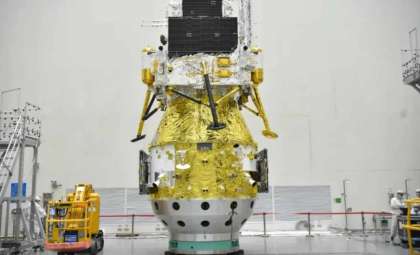
China has opted to delay the Chang’e 7 lunar mission, which was originally slated for launch this year, postponing a key initiative to investigate the moon’s south polar region.
This move represents a significant pause in China’s lunar exploration agenda, underscoring the nation’s emphasis on mission dependability ahead of undertaking intricate voyages into deep space.
Chang’e 7 Launch Deferred After Thorough Readiness Review
Following an in-depth assessment, Chinese officials concluded that the spacecraft was not fully prepared for the intended launch period, as reported by The Independent.

The Chang’e 7 mission is intended to mark a critical advance in China’s extended lunar survey plans, focusing on the moon’s south pole—a site of immense scientific interest due to potential ice reserves and promising future expedition opportunities.
Conceived as a multifaceted mission, it includes an orbiter, lander, rover, and additional scientific apparatus intended to provide a more detailed examination of the lunar environment than previous Chinese endeavors.
An official statement from Chinese authorities emphasized the importance of reliability: “Adhering to the principle of cautious and reliable progress to guarantee absolute success, the comprehensive evaluation determined that Chang’e 7 does not currently satisfy launch conditions and therefore will not proceed during the scheduled window this year.”
This decision reflects a risk-averse strategy necessary in space exploration, where failures can cause lengthy setbacks. Chinese space agencies prioritized readiness over adhering to the original timeline.
The Chang'e-7 lunar probe is scheduled for launch at an appropriate time, according to the China Manned Space Agency (CMSA).
The combination of the Chang'e-7 lunar probe and the Long March-5 Y14 carrier rocket was transferred vertically on Wednesday to the launching area at the… pic.twitter.com/IncqYF9Jyu— China Science (@ChinaScience) August 19, 2026
Essential Role in China’s Lunar Ambitions
The Chang’e 7 mission occupies a pivotal role in China’s comprehensive lunar agenda, designed to explore the south pole, a sector that has garnered international focus for its scientific value.
Unlike previous missions aimed primarily at technology demonstrations or sample recovery, Chang’e 7 was planned as a sophisticated research campaign. It intended to probe lunar materials, determine surface characteristics, and gather data essential for upcoming expeditions.
The lunar south pole’s permanent shadowed areas may harbor frozen water, a resource critical for sustaining human presence in space—this has attracted attention not only from NASA but also various other space organizations.
China has already accomplished notable successes through its Chang’e program, including the historic far-side landing by Chang’e 4 and the sample return mission of Chang’e 5.
While the delay adjusts the timeline, it does not cancel the mission. Chang’e 7 remains integral to China’s efforts to enhance lunar technology and obtain scientific insights from this scarcely explored lunar territory.
Postponement Highlights the Increasing Demands of Lunar Missions
The Chang’e 7 postponement exposes the escalating complexities involved in current lunar exploration, demanding advanced navigation, communication, and landing technologies to operate under harsh conditions.
The south pole features extreme temperatures, rugged terrain, and regions with minimal sunlight, necessitating exact landing and dependable post-touchdown functioning.
This cautious approach aligns with global trends where space agencies prioritize mission success over fixed launch dates, embracing thorough testing and scrutiny during preparation phases.
The postponement comes as lunar exploration experiences renewed international rivalry, with multiple nations and commercial entities striving to examine moon resources and pave the way for extended human activity beyond Earth.
Chang’e 7 was poised to offer critical data contributing to these endeavors. Its delayed launch will allow for further refinements, enhancing the prospects for a triumphant mission.
- Categories:
- News






0 comments
Sign in to Comment