

Over the past decade, China has been actively enlarging reefs and minor islets in the South China Sea, establishing ports, airstrips, and various other facilities within one of Asia’s most disputed maritime zones.
This extensive development is especially noticeable in the Paracel Islands, where satellite surveillance has revealed ongoing land reclamation efforts despite official claims that China had ceased creating new landmasses. These efforts have expanded China’s operational capability for aircraft, naval vessels, and surveillance apparatus across the region.
Small Islands Transformed into Strategic Outposts
The Asia Maritime Transparency Initiative report highlights continued construction in the Paracels beyond the earlier large-scale artificial island projects in the Spratly Islands that attracted global scrutiny.


An illustrative case is Tree Island, where satellite data indicated China’s dredging activity to build a new harbor and expand the island by approximately 25 acres since August 2015. Newly added installations include a helicopter landing pad, wind turbines, and solar power arrays.
Similarly, on North Island, about seven acres of reclaimed land were enclosed by a protective seawall. A previous effort to connect North Island with Middle Island using a causeway was destroyed by Typhoon Sarika in October 2016.

A gap found in the seawall suggests that a link between the islands might still be under consideration, although the AMTI report noted uncertainty about the project's completion.
Woody Island as a Military Hub
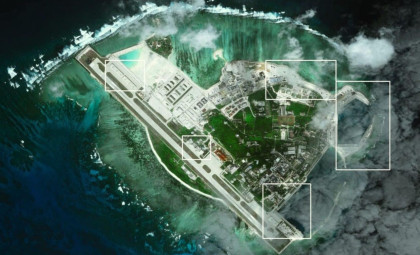
Woody Island represents the largest and most fortified Chinese facility in the Paracels and is described by AMTI as China’s principal military base in this archipelago.
By 2017, the island featured upgraded harbors and an airbase equipped with multiple hangars for fighter jets. The deployment of HQ-9 surface-to-air missile systems was also confirmed, and satellite images from March 2017 showed what appeared to be a Shenyang J-11 fighter stationed on the runway.

The broader network includes 20 Chinese-held outposts in the Paracels. Among these, three boast protected harbors suitable for large naval and civilian ship operations, while others maintain smaller docks or helicopter pads. Duncan Island supports a heliport with eight landing pads.
Other sites vary in development stage: Triton Island has a modest harbor and a fairly recent helipad, while Pattle and Money islands contain docks, helipads, and additional structures. Construction efforts, including harbor dredging, were ongoing on Drummond Island at the time of the report.

The report also notes that Vietnam has engaged in dredging and land reclamation activities in the Spratly Islands, though the scale remains smaller compared to China’s intense construction between late 2013 and mid-2015.
ASEAN Voices Concern Over Militarization
The extensive island-building campaign became a focal point during the 50th ASEAN Foreign Ministers’ Meeting held in Manila in August 2017.
Per the official joint communiqué, several ASEAN ministers expressed unease that reclamation and related endeavors have "eroded trust and confidence" and heightened regional tensions. The bloc urged peaceful dispute resolution in line with international regulations, including adherence to the 1982 United Nations Convention on the Law of the Sea.

ASEAN underscored the importance of non-militarization and restraint by all regional claimants and external actors. Concurrently, ministers welcomed progress in developing a Code of Conduct framework between ASEAN and China to regulate actions within these disputed waters.
Land Reclamation Transforms Strategic Terrain
The developments in the Paracels illustrate how minor maritime features can gain tremendous strategic importance once outfitted with permanent infrastructure.

While the physical increase in land area from dredging is significant, the greater impact arises from the subsequent establishment of harbors, airfields, missile defenses, and support facilities, raising the tactical potential of previously modest locations.
These changes contribute to ongoing tensions in the contested maritime zones, with ASEAN persistently advocating for restraint, peaceful dialogue, and compliance with international laws—even as the region witnesses profound shifts in military and infrastructural presence.
- Categories:
- News










0 comments
Sign in to Comment