

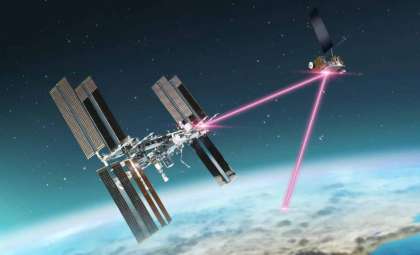
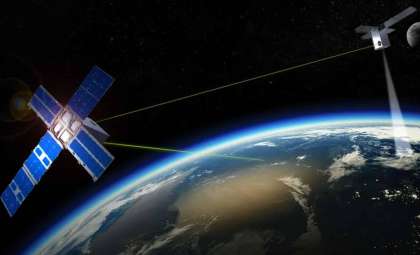
Sending a laser beam from a geostationary satellite requires it to travel nearly 36,000 kilometers before reaching the Earth's surface. However, the distance is only part of the challenge; the beam must also pass through the Earth's turbulent atmosphere, which distorts and scatters the light, resulting in a weak and blurry signal upon arrival.
Researchers in China have explored a novel approach that merges two techniques to better recover the distorted signals caused by atmospheric turbulence. This hybrid method enables the receiver to interpret signals that would traditionally be too scattered to decode.
The breakthrough demonstrated a 1 gigabit-per-second (Gbps) data link from a satellite situated in geostationary orbit using a modest 2-watt laser transmitter. As reported by the South China Morning Post on June 17, 2025, this rate was described as five times faster than comparable Starlink downlink speeds.


It’s important to note that Starlink satellites orbit just hundreds of kilometers above Earth, whereas this Chinese experiment’s laser originated from a geostationary satellite orbiting more than 60 times higher.
Atmospheric Turbulence Challenges Laser Signal Quality
While laser communications can deliver high data rates, the Earth's atmosphere remains a significant complication. Atmospheric turbulence causes scattered and diffused light, creating extremely weak spots on the ground that can extend over several hundred meters, as reported by the South China Morning Post.
Scientists have traditionally tackled this with two methods: adaptive optics (AO), which sharpens distorted light, and mode diversity reception (MDR), which extracts valuable information from scattered signals.
Neither technique alone is fully effective during intense turbulence. The Chinese research team combined AO and MDR so that the system first corrects main distortions and then retrieves data from the scattered components.

Led by Wu Jian of Peking University of Posts and Telecommunications and Liu Chao from the Chinese Academy of Sciences, the team called this dual-method system AO-MDR synergy.
This approach splits the correction process: adaptive optics initially mitigates the main beam distortion, and mode diversity reception then captures residual scattered signals effectively.
Enhanced Signal Recovery Achieves 91.1% Usable Rate
The integration of AO and MDR significantly improved the proportion of effective signal received. Published research stated that usable signal rates increased from 72% with a single method to 91.1% using the combined system.
This heightened clarity enabled the team to achieve a 1 Gbps optical downlink utilizing a relatively low-power 2-watt laser. The design paired a modest transmitter with a specialized receiver optimized to handle severe atmospheric disturbances.

According to the South China Morning Post’s coverage of the research paper, this technique "effectively prevents communication quality degradation caused by extremely low signal power."
Understanding the Starlink Comparison
The claim of outperforming Starlink by five times relates specifically to the recorded data transmission rate rather than direct network-to-network comparisons. Starlink satellites orbit at low Earth orbit altitudes, while the Chinese experiment operated from geostationary orbit at over 36,000 km.
This study focused solely on overcoming atmospheric effects on laser signals sent from space to ground. It does not represent a side-by-side test of satellite internet services with identical hardware or protocols.
In essence, researchers demonstrated a 1 Gbps geostationary laser downlink powered by a 2-watt laser combined with a novel receiver system utilizing adaptive optics and mode diversity reception. As detailed in the original study, this approach achieved a 91.1% usable signal rate under the combined correction method.
- Categories:
- News










0 comments
Sign in to Comment