

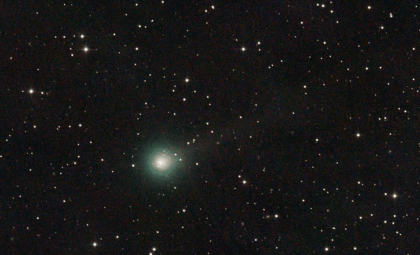
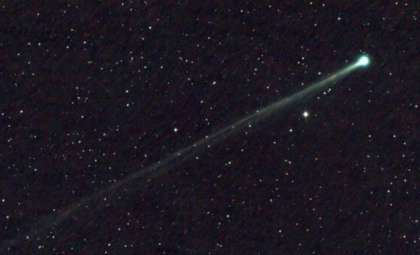
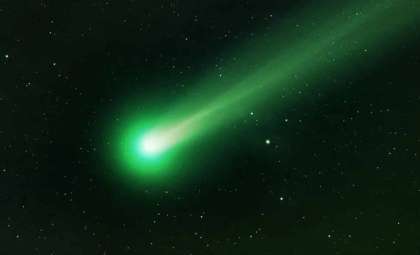
Astrophotographers Gerald Rhemann and Michael Jäger have captured a remarkable image of Comet 220P/McNaught glowing brilliantly green over Namibia, several months after an extraordinary flare-up increased its brightness by thousands of times. Their snapshot from August 8, 2026, reveals the comet’s striking green coma as it journeys through the inner solar system, transforming this typically faint visitor into a dazzling celestial spectacle.
Periodic Comet Exhibits Unexpected Brightness Surge
220P/McNaught, first identified by Australian astronomer Robert H. McNaught, follows an orbit around the Sun approximately every 5.5 years, moving closer to the Sun and then retreating to the outer solar system.
During its 2026 approach, especially near its June perihelion—the closest orbital point to the Sun—the comet experienced a significant outburst, increasing its brightness by about 8,000 times.

This dramatic enhancement occurs when solar heat triggers volatile substances beneath or on the surface of the comet, causing gas and dust to be expelled vigorously. Since observers detect sunlight reflected by the surrounding cloud, called the coma, rather than the comet’s small nucleus alone, a sudden release of material can cause a massive brightness jump.
Following this event, the comet’s activity persisted. By August, it remained highly luminous at some 600 times its usual brightness, as reported by Space.com. These conditions set the stage for the detailed photograph taken by Rhemann and Jäger.
Such observations highlight the comet’s dynamic nature—while its path around the Sun is predictable, the timing and intensity of active episodes remain uncertain.
Capturing the Comet’s Glow From Namibia on August 8
This image was captured in Namibia on August 8, 2026, during the comet’s period of heightened brightness. Astrophotographers Gerald Rhemann and Michael Jäger employed a 12-inch Astrograph telescope paired with a ZWO ASI 6200 MM Pro camera to record the scene.
Such advanced gear lets astronomers detect fine details and faint light that are invisible to the naked eye. The resulting photo shows the comet as a vivid green source set against a dense star field.
The image also illustrates the contrast between a comet’s physical nucleus—which is small and dark—and the glowing coma produced by gaseous and dusty material expelled from it.
Namibia offers ideal conditions for astrophotography: dark skies, minimal light pollution, and expansive views of the heavens. While these conditions don’t intensify the comet itself, they enable capturing faint celestial features more clearly.
By combining an active comet, sophisticated instrumentation, and an excellent location, this image reveals much more than a casual glance could from Earth.

What Causes the Comet’s Distinctive Green Hue?
The vibrant green color of the comet’s coma is genuine and results from interactions between solar radiation and gases released by the comet’s nucleus.
A key contributor to this green glow is often the molecule diatomic carbon (C2). When sunlight excites these molecules in the coma, it causes them to emit light at wavelengths that appear green.
This green tint usually surrounds the coma itself and does not extend far into the comet’s tail, as the responsible molecules break down under ultraviolet solar radiation as they drift away.
This color provides scientific insight beyond aesthetic appeal, linking the visual spectacle to chemical and physical processes triggered by solar heating on this icy solar system body.
Comets are composed of frozen volatiles, dust, and rocky debris that date back to the solar system’s infancy. Each solar approach warms these materials, which can activate or change active regions on the comet.
Thus, seeing a green comet reflects the unfolding interaction between solar energy and cometary substances in real time.
An 8,000-Times Brightness Increase Indicates a Powerful Outburst
The most remarkable aspect of 220P/McNaught’s 2026 passage was its reported about 8,000-fold surge in brightness during the June outburst.
Outbursts in comets represent sudden bursts of gas and dust release. Multiple mechanisms might trigger such events, including exposure of fresh volatile material, internal pressure causing surface fractures, or thermal stresses disrupting the nucleus.
Brightness measurements alone cannot pinpoint the exact cause here; comprehensive monitoring of the comet’s evolution, composition, and dust emissions before, during, and after the event would be necessary.
Nonetheless, the dramatic brightness enhancement underscores how rapidly a faint comet can become conspicuous once fresh material envelopes it.
By August, although no longer at the peak brightness of the June event, the comet remained unusually active, shining some 600 times brighter than usual when photographed in Namibia.
This sequence—a perihelion approach, a major outburst, and subsequent heightened activity—makes the 2026 appearance a particularly noteworthy episode in the comet’s recurring solar orbits.
- Categories:
- News


0 comments
Sign in to Comment