

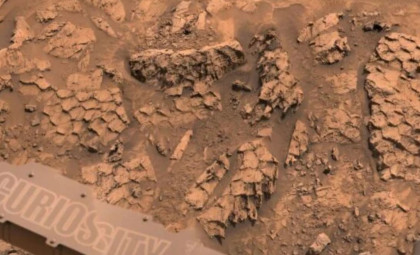
While exploring Valle Grande on the slopes of Mount Sharp, NASA’s Curiosity rover has identified an extensive area marked by polygonal fracture patterns. These intricate, honeycomb-like designs extend over a larger region than any previously recorded during the mission, sparking curiosity about their origin.
The rover's journey through the valley revealed these geometric polygons, ranging from 4 to 8 centimeters (1.5 to 3 inches) across, also present near a nearby butte called Miraflores—a sandy-capped, six-meter-high geological formation.
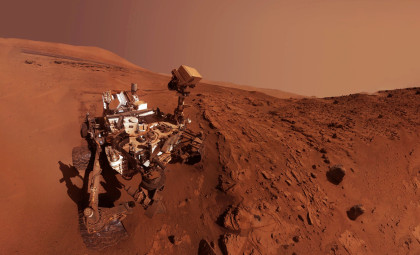
Since its touchdown on Mars on August 5, 2012, Curiosity has been examining Gale Crater's geological layers and Mount Sharp’s foothills. The rover has uncovered signs indicating that ancient Mars hosted water, essential chemical elements, and environmental factors suitable for microbial life.

According to NASA’s Jet Propulsion Laboratory, researchers are analyzing both the shapes and chemical signatures of these polygons to better understand the geological forces that sculpted this unusual terrain.
Geometric Features Expansive on Martian Surface
Curiosity documented the polygonal terrain via a 360-degree panoramic view captured over June 19 and 20, 2026, corresponding to the rover’s 4,930th and 4,931st Martian days, or sols. The images reveal the patterns sprawling as far as the rover’s cameras allow sight.
Though smaller polygonal textures have been spotted before, the field in Valle Grande stands as the largest and most concentrated area recorded by Curiosity thus far. These designs extend over the ground and curve around Miraflores, offering an expansive study area.

The Miraflores butte rises roughly 6 meters (20 feet) and is topped with a thick layer of sand. Its location within this polygonal environment provides an additional geological reference for comparison.
“We’ve seen a lot of fascinating landscapes through Curiosity’s eyes, but this sea of polygons took our breath away,” said Ashwin Vasavada, Curiosity’s project scientist at NASA’s Jet Propulsion Laboratory in Southern California. “We measured their shapes and chemistry carefully and are hopeful there are clues in the data as to how these features formed.”
Scientists are now evaluating whether these polygons share similarities with those discovered in other Martian regions to determine their origin.
Decoding the Formation of Martian Polygons
The cause of these newly observed fractures is still unclear. Polygons on Mars may result from various geological processes, and researchers are exploring several hypotheses based on prior findings. For instance, some of Curiosity’s earlier observations pointed to polygons as dried mud cracks, formed when water-rich sediments shrink and fracture during drying.
Other formation mechanisms include cyclical thermal expansion and contraction driven by fluctuating temperatures or the expulsion of water from sediments under pressure, altering the ground’s structure.

Researchers are analyzing these polygons’ dimensions, shapes, and chemical makeup to uncover clues about the post-depositional history of the sediments. This investigation furthers Curiosity’s overarching goal of understanding Mars’ transition from a once watery world to the arid planet observed today.
Insights From Curiosity’s Mars Exploration
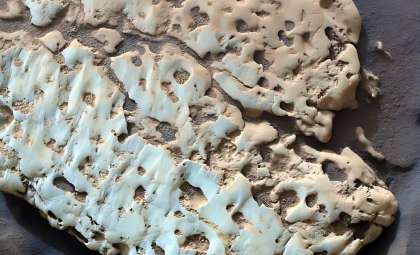
After over a decade on Mars, Curiosity has examined numerous intriguing features, including sulfur-bearing crystals and rare meteorites embedded in Gale Crater. One milestone is the discovery of conditions that would have supported microbial life when lakes and streams existed on Mount Sharp’s lower slopes billions of years ago.
The rover also detected organic carbon compounds preserved within Martian rocks, which are critical to organic chemistry related to life, encompassing molecules akin to RNA and DNA that carry genetic information.

NASA researchers note that these organic molecules may originate from biological or abiotic processes, so their presence doesn’t confirm past life. Nevertheless, their discovery supports the idea that ancient Mars offered chemical ingredients essential for habitats where microbial life was possibly sustainable.
- Categories:
- Space


0 comments
Sign in to Comment