

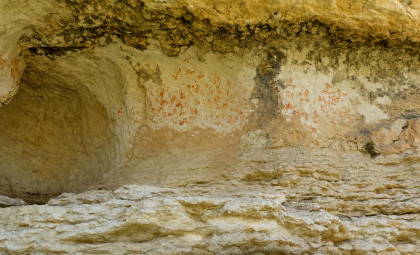
The Huashan rock paintings have remarkably endured over two millennia, clinging to cliffs in southern China despite relentless heat, humidity, typhoons, and heavy rainfall. Scientists have uncovered a key element of the secret to their longevity: a unique blend of lime, red clay, and blood, with evidence suggesting the blood may have originated from women in childbirth.
Spanning more than 80 locations over approximately 260 kilometers along the Zuojiang River valley in Guangxi Zhuang Autonomous Region, these artworks date from the 5th century BCE to the 2nd century CE and portray scenes of humans, animals, and bronze items.
Researchers have long wondered how the red pigment has remained vibrant despite harsh environmental conditions, including summer temperatures frequently above 40°C and cyclical exposure to heavy rain and typhoons. An international research effort led by Shandong University and the Guangxi Museum of Anthropology studied dislodged fragments from Gaoshan, Daningshan, and Tupingshan to uncover the mystery.

More Than Just Pigment: A Structured Mortar Beneath the Surface
The ancient creators did not merely paint pigment on limestone surfaces. Underneath the pigment, scientists discovered a delicate layer of engineered mortar, containing calcium carbonate, calcium phosphate, silicates, sulfates, and proteins. Published in the Journal of Archaeological Science, research shows this layer ranges in thickness from as little as 1 micrometer at Tupingshan to 150 micrometers at Gaoshan. The particles forming this layer were highly consistent and measured less than 3 micrometers, unlike the uneven sediments found nearby.
The contrast was stark. Some of the Gaoshan fragments were so solidly bonded that removing them required an electric drill, whereas nearby natural sediments fragmented with ease.

Previous hypotheses suggested plant sap rich in oxalic acid aided adhesion, but this fresh analysis reveals that a crafted biomineral mortar provided the lasting bond.
Ancient Blood Occurs Within the Mortar Composition
The investigation identified traces of blood serum proteins such as albumin, fibrinogen, and immunoglobulins in every examined fragment. Samples were cleaned with ultrasound to remove contamination and researchers analyzed protein deamidation to confirm these biological markers were genuinely ancient.
At Gaoshan, more than 97% of detected proteins aligned with Homo sapiens. The Daningshan samples featured a mix of 61% human and 39% bovine proteins. Intriguingly, two proteins detected—prolactin-inducible protein and lactotransferrin—are typically abundant in the breast milk and blood serum of pregnant or nursing women but less common in others.

No casein, the main milk protein, was detected, ruling out the use of milk. Scientists suggest the blood likely originated from women during childbirth, possibly linked to birthing or postpartum bleeding. This theory aligns with the Luoyue people, thought to be responsible for the paintings, and with imagery expressing themes of pregnancy, intimacy, and prominent male genitalia. Remarkably, researchers estimate that only about 8 milliliters of blood could cover one square meter of painted surface.
Blood Was Just One Element: Calcium Carbonate Cemented the Pigments
While the presence of blood is noteworthy, calcium carbonate was the critical agent solidifying the pigment's bond. Lime, exposed to air, formed calcium carbonate crystals around the pigment particles, effectively fusing them to the rock.
“This stable organic-inorganic composite bonding system reveals the complex technological processes used by the creators and explains why the Huashan rock art has survived so well in such challenging conditions for over two millennia,” said the study authors.
The mineral layer's durability surpasses that of purely organic adhesives in hot, humid environments. A sample from Tupingshan serves as evidence—after calcium carbonate was lost, leaving only oxalate and phosphate, the pigment easily peeled off.
“Clearly, it is the calcium carbonate, not the calcium oxalate, that bonds the pigment to the base rock,” they added.

All materials needed—limestone, shells, clay, bones, and blood—were locally sourced. Lime was produced by heating limestone, while bones or guano contributed phosphate. According to researchers, the main challenge lay not in labor but in the precise preparation and combination of these substances.
“These findings provide new insights into the creation of prehistoric rock art, showing that it was a technically intensive project rather than a labor-intensive one.”
- Categories:
- Science





0 comments
Sign in to Comment