

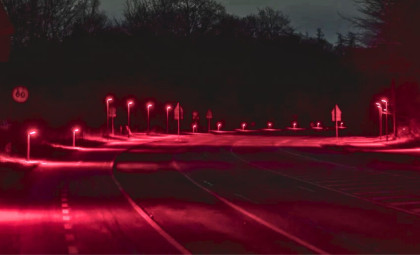
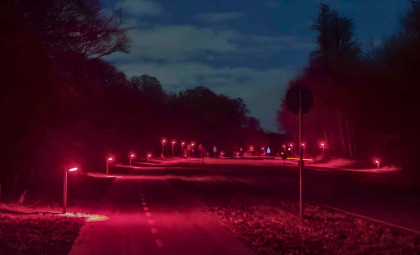
Near Skovbrynet in Gladsaxe, Denmark, a section of Frederiksborgvej takes on an uncommon appearance after sunset. Instead of the usual white glow, this stretch is bathed in red light.
This striking choice isn’t for aesthetics alone. A colony of bats inhabits the area adjacent to this part of Frederiksborgvej, presenting a unique challenge during recent lighting upgrades. While darkness benefits the bats, the road still demands sufficient illumination to ensure the safety of drivers and cyclists.
To address this, Gladsaxe Municipality installed red street lighting near the bat habitat, guided by studies showing that longer-wavelength red light disturbs bats significantly less than blue, green, or white lights with shorter wavelengths.

Seven Bat Species Identified Alongside Frederiksborgvej
According to Gladsaxe Municipality, seven distinct bat species have been documented in the vicinity of the road. None are currently listed as threatened or red-listed according to the project details.
Special focus was placed on two species, the common pipistrelle, noted as the region’s most prevalent bat, and the long-eared bat, both considered more vulnerable to impacts from road environments. This insight comes from research prepared for the Danish Road Directorate by Julie Dahl Møller and Hans J. Baagøe.

Gladsaxe notes that 13 bat species are found across Denmark. The most frequently observed include the serotine bat, common pipistrelle, parti-coloured bat in North Zealand, and Daubenton’s bat, though their presence varies by location.
The bat colony became a key consideration in the decision-making process for renovating Frederiksborgvej’s lighting, leading to tailored lighting strategies rather than uniform installation along the entire roadway.
Studies Support Using Longer-Wavelength Red Lighting
Artificial lights are known to influence bat behavior, stated research highlighted by Gladsaxe Municipality. Therefore, the focus wasn’t just on providing illumination but selecting lighting that would minimally disrupt local bat populations.
Drawing on Dutch studies, the municipality found that light with shorter wavelengths—such as blue, green, and white—tends to interfere more with bat activity compared to longer-wavelength red light.
The municipality also noted that red lighting is preferable during hunting periods, as it affects foraging activity less for most bat species.

While total darkness would best support bat ecology, it wasn’t feasible for a road requiring illumination. Consequently, red lighting was selected as a balanced solution for the bat-inhabited segment.
Jonas Jørgensen, a road engineer in Gladsaxe Municipality’s Traffic and Mobility department, explained the goal was to minimize environmental impact without sacrificing safety for road users.
Light Bureau emphasized that the lighting design was informed by bat-friendly studies aimed at reducing the disturbance of nocturnal wildlife. The company added that this approach helps pedestrians and cyclists navigate while preserving their night vision.
Warm White Light Used at Intersections for Safety
Not all the lighting along Frederiksborgvej was switched to red.
Where traffic intersects and cyclists cross, the municipality installed warm white light on taller poles. This setup enhances visibility, addressing safety concerns at busy spots.
The lighting solution is therefore location-specific: red lights around bat habitats and warmer white lights where increased visibility is essential.

Mayor Trine Græse described the initiative as a thoughtful balance between maintaining traffic safety and supporting biodiversity, linking it to the municipality’s broader commitment to the United Nations Sustainable Development Goals.
Red Lighting Also Highlights Protected Natural Zones
The striking red hue was intended to convey more than just practical benefits.
Philip Jelvard, a lighting designer at Light Bureau, explained that it serves as a visual cue to those passing by, indicating the area’s special environmental status.

“Overall, we hope that everyone welcomes the new lighting and that the red light not only has functional value, but also symbolic value. The red light should make passers-by aware that this is a special natural area that we want to protect,” Jelvard said.
Gladsaxe’s announcement acknowledged the adjustment period needed for both humans and bats. Light Bureau anticipates these innovative lighting adjustments will benefit the local bat populations.
The lighting overhaul was part of a larger Gladsaxe project replacing approximately 5,000 light fixtures. On Frederiksborgvej, this meant a roadway where lighting color and location were customized with the local bat colony's welfare in mind.
- Categories:
- News







0 comments
Sign in to Comment