

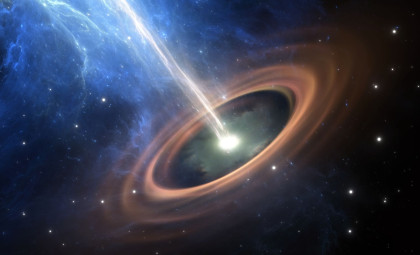
Researchers have uncovered three actively feeding black holes within a single galaxy located more than 12.5 billion light-years from Earth, offering an unprecedented view of black hole development during an era when the universe was just around 1.2 billion years old. This breakthrough, published in Astronomy & Astrophysics, was achieved by an international collaboration led by the Max Planck Institute for Extraterrestrial Physics utilizing data from the James Webb Space Telescope. Two of these black holes lie near the galaxy’s core, with a third situated several thousand light-years away. Their detection hints at early galactic interactions and mergers that brought multiple massive black holes together in the young cosmos. This finding also provides insight into early phases that may precede future black hole mergers and the gravitational waves such events could produce.
A Rare Triple Black Hole Assembly in the Early Cosmos
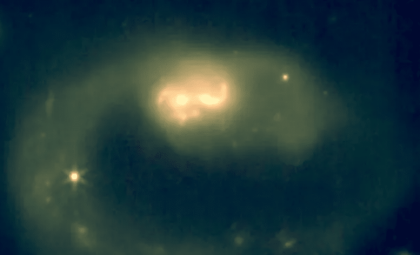
The galaxy, known as J0148-4214, is observed at a redshift of z = 5.02, corresponding to a period when the universe was in its infancy. The light from this galaxy has traveled approximately 12.5 billion years, enabling scientists to analyze it as it existed roughly 1.2 billion years after the Big Bang. Due to cosmic expansion, the galaxy’s light shifts toward longer wavelengths, resulting in the measured redshift. What stands out in this observation is not only the galaxy’s distance and age but the presence of multiple active black holes within it. Two of these black holes are situated near the galactic center, separated by about 620 light-years in projection.
The third black hole is found in the galaxy’s outer region, roughly 5,500 light-years away from the center. All three are actively consuming matter, with gas inflow generating hot accretion disks that emit detectable radiation. The researchers were able to isolate the activity of each black hole through their distinct spectral signatures. “This represents the first detection of three active black holes in a single distant galaxy,” explains Hannah Übler, head of the research group at MPE and lead author of the study. This result offers an exceptional window into how multiple black holes can coexist and grow within one young galaxy.


This discovery aligns with a wider paradigm in which young galaxies frequently interacted, collided, and merged. In today’s universe, many large galaxies are thought to have formed through extensive merger histories, with their central black holes evolving alongside. When galaxies merge, their central black holes may eventually become a gravitationally bound pair and merge after eons. Detecting three active black holes in one primordial galaxy suggests such processes were already active in the early universe. The outer black hole might be a vestige of a past merger, a black hole displaced from the center by gravitational recoil, or gradually infalling. Hence, this system may capture multiple stages of black hole growth in a single young galaxy.
“It suggests that processes in the early universe were efficient at bringing massive black holes together, setting the stage for the massive black hole mergers we expect to detect with future gravitational wave observatories,” says Übler.
If the inner pair continues to lose orbital momentum, they could merge within several hundred million years. Such a collision would form a more massive black hole and contribute to the expected population of massive black hole mergers that future gravitational wave detectors will observe.
James Webb's Unique Capabilities Reveal What Was Previously Hidden
The team detected the black holes through their distinctive spectral emission lines, especially hydrogen gas moving at high speeds near the strong gravitational fields of the black holes. The inner two black holes are so close that they appear blended in typical images at this extreme distance, making it challenging to distinguish individual sources. Their combined spectrum shows complex features revealing at least two separate active regions.
To solve this, researchers employed spectro-astrometry, a method analyzing subtle shifts in emission line positions across different wavelengths. This technique can locate different emitting regions even when normal imaging doesn’t clearly separate them. Using this approach, the researchers pinpointed the locations of the two central black holes. The third was identified in the galaxy’s outskirts, marked by spectral signatures of an additional actively feeding black hole.

The data was gathered through JWST’s NIRSpec integral field spectroscopy, which uniquely combines spectral and spatial information across the galaxy. This ability was crucial, as a traditional spectrum would have blended the signals, hiding multiple sources. Without spatially resolved spectroscopy, only one active black hole might have been detected. This discovery highlights Webb’s power to translate subtle spectral variations into detailed knowledge of the structure and formation of the most distant galaxies.
- Categories:
- Astronomy


0 comments
Sign in to Comment