

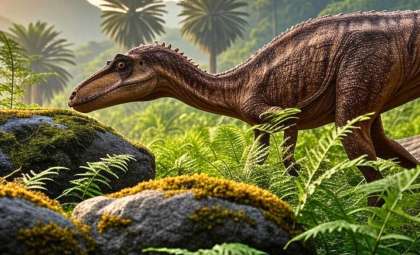
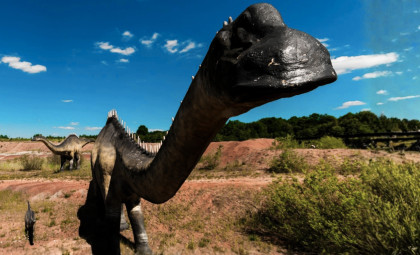
A recently unearthed dinosaur from southern China has the potential to reshape our understanding of sauropod distribution across Asia. Dubbed Yantaloong lini, this long-necked dinosaur appears to be the inaugural Turiasauria member discovered on the eastern Asian continent.
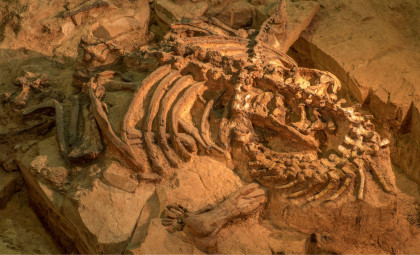
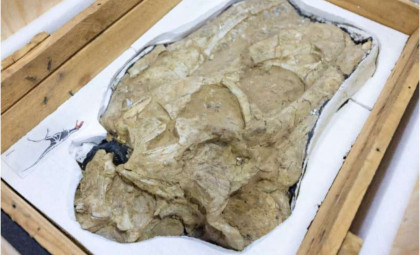
The fossils were recovered from Yunnan province, where scientists identified six vertebrae dating back to the middle Jurassic period, 174 to 161 million years ago. Although fragmentary, these remains provided sufficient evidence to classify the dinosaur within a highly debated branch of the sauropod lineage.
Research conducted by experts at the Geological Museum of China suggests that Yantaloong lini belongs to the Turiasauria clade, a group of large sauropods previously known only from Europe, North America, Africa, and India. This finding indicates that turiasaurians also roamed the territory of modern-day China.

These insights arrive amid ongoing debates about the evolutionary relationships between turiasaurians and other sauropods, a topic that has seen several revisions since the group's initial identification in 2006.
An Addition to China's Jurassic Dinosaur Fauna
China's middle Jurassic period was already recognized for a diverse dinosaur lineup, including the well-known mamenchisaurids, noted for their exceptionally elongated necks, alongside other early sauropods.
Yet, the evolutionary link bridging mamenchisaurids and later-evolving neosauropods remained missing in the fossil record for east Asia.
The identification of Yantaloong lini might close that evolutionary gap. Detailed comparisons of its vertebral morphology with other sauropods frequently placed this species within a distinctive variant of Turiasauria.

This group encompasses dinosaurs like Lapparentosaurus, Jobaria, and Atlasaurus. While some analyses proposed placements outside classical turiasaurians or within Neosauropoda, these scenarios were deemed less plausible by the researchers.
An Evolutionary Mosaic Dinosaur
The vertebral fossils of Yantaloong lini exhibit a fascinating blend of primitive and derived traits. This dinosaur shares features common to more advanced sauropods like dicraeosaurines and titanosaurs while retaining characteristics typical of older eusauropods. As detailed in the published study from the Zoological Journal of the Linnean Society, these anatomical details help reconstruct the evolutionary changes in sauropod skeletons. Noteworthy are traits such as pneumatization, which created hollow spaces in bones, and the hyposphene-hypantrum complex, providing additional spinal support.

The presence of these characteristics supports the hypothesis that Yantaloong lini occupied a position near the evolutionary threshold leading to Neosauropoda. Because its anatomy does not fit perfectly into existing categories, the species offers a valuable insight into sauropod evolution.
The phylogenetic placement of Yantaloong lini remains under active investigation, reflecting the dynamic nature of interpreting dinosaur evolutionary ties as new discoveries emerge.
Revealing East Asia's Jurassic Giants
Prior to this discovery, evidence of Turiasauria ranged from the lower Jurassic to the lower Cretaceous across several global regions, yet none had been confirmed in east Asia. The identification of Yantaloong lini fills this geographic gap. According to the researchers:
“The new species probably represents the first discovery of a turiasaurian sauropod in China and even in East Asia.” The fossil gives scientists a new reference point for studying how these large herbivorous dinosaurs spread across ancient continents.

Though these fossils don't answer every question about turiasaurian evolution, they provide crucial new data enriching our understanding of the Jurassic era and sauropod ancestry.
- Categories:
- Science



0 comments
Sign in to Comment