

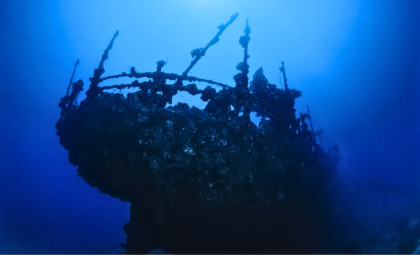
Along a secluded portion of the Yucatán’s Caribbean shoreline, nineteen cannons and four anchors have rested on the ocean floor for over two and a half centuries, marking the demise of a vessel that was never supposed to navigate these waters. Archaeologists have now meticulously reconstructed the ship’s final moments, revealing a tale less about a storm and more about covert smuggling along a territory the Spanish Empire hesitated to chart.
This shipwreck, named Ánimas de la Victoria, lies within Espíritu Santo Bay inside the Sian Ka’an Biosphere Reserve, approximately 4.25 kilometers offshore from the fishing village of La Victoria. This remote, roadless region of Quintana Roo has helped preserve the wreck site undisturbed for centuries.
The findings, detailed in the Journal of Maritime Archaeology, represent the only identified 18th-century shipwreck within this bay, offering critical insights into an era when Spain and Britain were covertly vying for control over Caribbean trade routes.

What puzzles researchers most is the wreck’s unusual location. Ships of the Spanish fleet rarely traversed these hazardous, reef-filled waters, which fell far outside the Crown’s designated maritime passages through the Yucatán Channel. This raised a fundamental question: what business did this ship have here?
A Submerged Path Marked by Anchors and Artillery
The wreckage forms not one concentrated area but a scattered trail stretching nearly 200 meters from east to west, heading toward the reef’s surf, with depths varying between 1.5 and 7 meters. Lead investigator Helena Barba-Meinicke suggests this dispersion charts a sequence of desperate maneuvers by a ship attempting to avoid disaster.
Each of the four anchors reveals different insights based on their construction. Anchor 1, diminutive in size, features straight “V”-shaped arms typical of British design but matches the proportions of a 1731 French model. It was likely a small kedge anchor used for intricate movements inside the bay.

Anchor 2, found piled beneath Anchor 1, displays curved arms characteristic of the Early Modern era and was probably deployed as a stream anchor in gentler currents. Anchor 3, the largest, features a shank length of 4.70 meters, dimensions more common to 16th- and 17th-century anchors, which suggests it was crafted decades before the wreck occurred. The most westerly, Anchor 4, bears a bent shank, indicating it was likely damaged while being hauled.
Cannons Bearing an Enigmatic Mark
The 19 iron cannons presented a challenge to identification due to heavy encrustations of coral growth. After painstaking hand cleaning with chisels, hammers, and wire brushes, investigators discovered a pronounced letter “C” stamped on the trunnions of two cannons, C8 and C10. This letter may signify either the Le Creusot foundry in Burgundy, France, or the Conster foundry in Sussex, England, which produced cannons between 1700 and 1760 and notably armed ships like the HMS Bedford in 1778.

A separate four-pounder cannon extracted by local fishermen years ago and now privately held also aligns with British mid-18th-century casting methods. Considering the estimated weight of Anchor 3 at about 1,650 kilograms, derived from British naval records, the vessel is approximated to have measured between 650 and 700 tons burthen. The research paper concludes:
“The ship of the Ánimas de la Victoria wreck must have been larger in size, built as a merchant frigate or, more likely, as an armed merchant vessel with similar artillery.”
Uncharted Waters the Spanish Avoided
The leading hypothesis is that the ship engaged in smuggling activities. The eastern Yucatán coastline was nearly uncharted by Spain—featuring no significant ports, very few settlements, and mostly dense jungle and treacherous reefs. The nearest known Spanish presence was the isolated inland outpost of Bacalar.
The researchers note that Spanish maritime guides reflected this avoidance. Even in 1810, the Pilot Guide of the Antilles Islands offered no navigation advice north of the Belize River and explicitly warned sailors to steer clear of the reefs. This suggests that, well into the 19th century, the waters around Espíritu Santo Bay were influenced more by British sailors and indigenous Maya navigation traditions than by Spanish control.

The study emphasizes that investigations into the Ánimas de la Victoria site are ongoing, with the potential to shed new light on the maritime history of the northwestern Caribbean, especially focusing on the eastern Yucatán coast and Belize.
- Categories:
- Science






0 comments
Sign in to Comment