

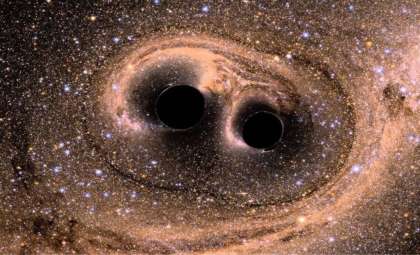
Researchers have identified two supermassive black holes actively accreting material simultaneously within the compact galaxy J1622+3521. These black holes are separated by roughly 27,000 light-years and represent the first confirmed dual active galactic nuclei observed in a Green Pea galaxy.
Green Pea galaxies are characterized by their small size, low metallicity, and high rate of star formation relative to their mass. These features mirror those seen in swiftly evolving galaxies from the early universe, making nearby examples invaluable for detailed astrophysical study.
Until now, no evidence had confirmed the presence of two simultaneously active black holes within a Green Pea galaxy. A research group led by Konstantinos Kouroumpatzakis at the Czech Academy of Sciences utilized data from Chandra and Keck observatories to locate this elusive dual system. Their findings were submitted to the arXiv preprint server on July 20, 2026.

Chandra Detects Two Distinct X-Ray Emission Sites
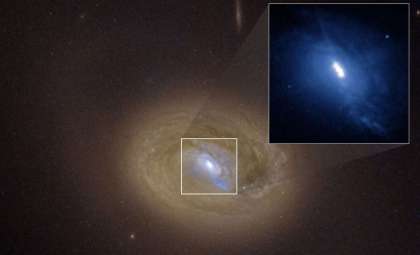
The galaxy J1622+3521 already attracted attention because of its irregular structure. Deep optical imaging revealed the presence of two nuclei, along with faint tidal streams and debris indicative of an ongoing galaxy merger. Scientists investigated if both nuclei housed feeding black holes. Observations from NASA’s Chandra X-ray Observatory confirmed the presence of two separate X-ray sources spatially aligned with the optical cores.
The two black holes are spaced roughly 8.4 kiloparsecs, or about 27,000 light-years, apart and have comparable masses. One has an estimated mass of around 19.5 million times that of the Sun, while its companion is approximately 20.5 million solar masses.

The matching pairs of optical nuclei and X-ray sources strongly indicate that J1622+3521 harbors two actively feeding black holes rather than a single central source.
Keck Observatory Illuminates the Galaxy's Inner Dynamics
Further insights came from observations taken at the Keck Observatory. Spectral analysis revealed prominent emission lines, including rare high-ionization lines typically produced by energetic radiation from an active galactic nucleus (AGN).
The team also measured the redshift of each nucleus. The measured velocity difference was only about 7 kilometers per second, consistent within the margin of error. According to the recently published paper, this supports the notion that both cores share a common systemic velocity. Combined with the observed tidal features, this suggests a pair of interacting galaxies whose central black holes have yet to merge.

The researchers applied an additional diagnostic to differentiate radiation from black hole activity versus star formation. This method clearly placed the galaxy within the AGN category. The publication described this evidence as “independently supports the dual-AGN interpretation inferred from the X-ray luminosities and broad Balmer emission.”
Why This Compact Galaxy Captivates Astronomers
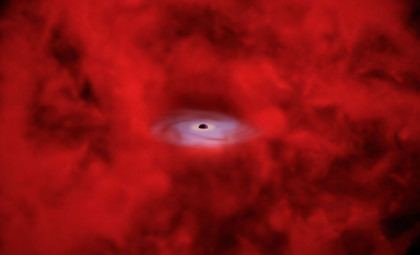
The team conducted one more validation by comparing He II emission with the system’s X-ray output. The correlation found between ionizing radiation and accretion was consistent with expectations for genuine AGN activity. However, some emissions might remain obscured by dense gas clouds, which higher-energy X-ray observations could help uncover.
The remarkable aspect of this discovery lies in the nature of the host galaxy. Green Pea galaxies provide a local window into the conditions of star formation and black hole growth that dominated in early cosmic times. These observations demonstrate that two supermassive black holes can accrete mass simultaneously during a merger, even within a small, low-mass galaxy.

This makes J1622+3521 the first validated example of dual supermassive black holes actively feeding within a Green Pea galaxy, featuring two nuclei, corresponding X-ray sources, and black holes each weighing close to 20 million solar masses.
- Categories:
- Space


0 comments
Sign in to Comment