

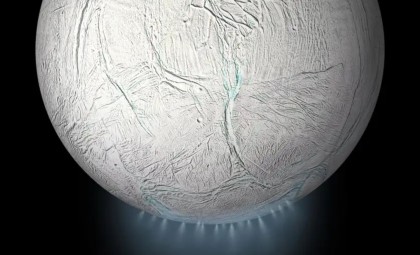
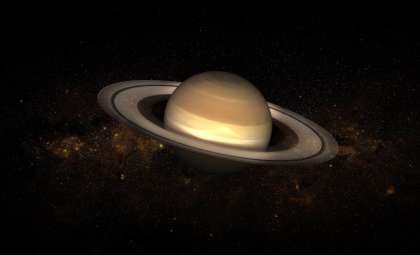
Researchers investigating Enceladus, one of Saturn’s moons, have uncovered that its icy geysers might naturally separate and concentrate ocean materials from beneath its crust. This mechanism could facilitate upcoming missions in detecting potential signs of life by examining the individual ice particles ejected from the moon.
Published in Science Advances, the study led by Frank Postberg from Freie Universität Berlin demonstrates that the ocean droplets rising through Enceladus’ ice shell freeze gradually instead of instantly. This slow freezing permits chemical components to separate within droplets before they escape into space.
Known for its potential to harbor life, Enceladus contains a subsurface ocean beneath a thick icy layer, where water, minerals, and chemical interactions could support biological processes.

From cracks near the south pole, powerful cryovolcanic jets release water and other materials into space, enabling direct sampling. NASA’s Cassini mission previously detected salts, organic molecules, and evidence of hydrothermal activity in these plumes.
Natural Separation of Ocean Compounds in Ice Droplets
The investigation analyzed how water from Enceladus’ ocean transitions from subsurface to space via ice fractures. By combining Cassini data, experiments, and theoretical models, scientists showed that droplets freeze progressively, allowing substances dissolved in the ocean to form distinct groups within ice grains.
For instance, sodium chloride separates from sodium carbonate during this process, effectively sorting chemical species before collection by spacecraft.

These frozen droplets are propelled through narrow fissures at speeds reaching 1,000 kilometers per hour, fragmenting upon contact with the walls into micrometer-sized particles.
“Enceladus actually does a lot of the work for us in preparing samples for analysis that usually take a lot of effort in chemical labs on Earth,” said Frank Postberg, explaining that the moon’s natural processes separate and concentrate ocean material in ways that normally require complex laboratory techniques.
Ice Particles as Enhanced Biosignature Carriers
If microscopic lifeforms are present in Enceladus’ hidden ocean, the freezing mechanism might concentrate their biological markers into select ice grains rather than dispersing them evenly throughout the plume. This concentration could improve biosignature detection efficiency for future missions analyzing individual ice particles.
The initial publication emphasizes that detecting life often hinges upon identifying concentrated chemical signals amidst a complex mixture.

Scientists at Freie Universität Berlin have previously evaluated instrument technologies capable of detecting microbial signatures in tiny particles comparable to those emitted by Enceladus. The current discovery enhances understanding of how these particles preserve and segregate moon’s ocean materials.
Simulating Enceladus’ Ocean for Microbial Viability
Another investigation featured in Science Advances explored whether an Earth microorganism could endure Enceladus-like oceanic conditions recreated in the lab. These conditions included minimal oxygen, high carbonate levels, and strong alkalinity with pH ranging from 10 to 11.
The microorganism tested was Methanothermococcus okinawensis, a methane-producing archaeon living in Earth's deep-sea hydrothermal vent environments, relying on hydrogen and carbon dioxide rather than oxygen.

The results were surprising: under laboratory alkaline conditions, the microbe's growth was limited by available dissolved carbon dioxide. However, in the simulated Enceladus ocean, it thrived, producing methane by metabolizing hydrogen generated through reactions between water and rock.
“This was really a surprise to us,” said Nozair Khawaja, who contributed to the study, explaining that the researchers had not expected such a successful outcome.
- Categories:
- Space




0 comments
Sign in to Comment