

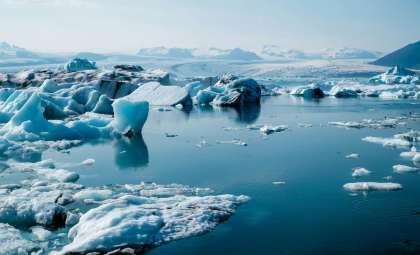
An underwater robot equipped with cameras unveiled an astonishing marine world beneath Greenland’s icy waters. The device recorded an active habitat thriving next to a glacier, showcasing creatures such as shrimp, fish, and jellyfish congregating around sediment streams flowing like underwater cascades from the ice.
TheCaptured footage is from Naajat Sermiat, a glacier situated in South Greenland that presents significant hazards for human explorers due to unpredictable ice calving events. To overcome these risks, scientists from Aarhus University in Denmark and the Geological Survey of Denmark and Greenland deployed a remotely operated vehicle (ROV) instead of divers to investigate underwater conditions safely.
Initially, Arctic oceanographer Fleur Rooijakkers and her research team aimed to study the behavior of glacial meltwater as it enters the ocean, particularly its unusually low temperature that dips below the freshwater freezing point. But the mission revealed a vibrant ecosystem coexisting at this glacier boundary, as detailed in a study published in Communications Earth & Environment.

Thriving Life at the Interface of Ice and Ocean
The researchers reported their discoveries in August 2026 through Communications Earth & Environment. When the ROV first entered the frigid waters, the team was focused on monitoring how meltwater behaved and hadn’t anticipated encountering such biological richness in the area.
“The initial idea for the ROV was to see what happens to the meltwater once it gets released into the ocean,” explained Fleur Rooijakkers. “Specifically, we wanted to see whether the meltwater could refreeze, since it comes into the ocean with temperatures below zero, below the freshwater freezing point.”

During the initial exploration, the ROV’s cameras quickly spotted fish. Following dives and footage by filmmakers Lars Ostenfeld and Antoine Drancey revealed a diverse community clustered near the glacier, including numerous shrimp-like krill, fishes, marine worms, crustaceans, amphipods, copepods, and crab larvae. Some species were even observed resting on the glacier itself.
While it was previously known that the vicinity of Greenland’s glaciers attracted fish, the extent and variety of life found so close to the ice edge was unforeseen. One striking discovery for Rooijakkers was the sediment’s unusual pattern as it tumbled down from the glacier into the ocean.
“I was really surprised by the structure of the ice and the sediments falling from the ice as if they were waterfalls,” Rooijakkers shared with ScienceAlert. “Though mesmerizing, it was hard to tell what it was initially, and took me a couple of watches to see that it was sediment falling on top of the ice.”
Glaciers as a Nutrient Source for Marine Life
Footage showed krill actively moving toward sediment clouds emerging from the glacier. Researchers believe these sediment flows might transport nutrients from melting ice into the neighboring waters, potentially fueling a localized food web.
According to ScienceAlert, the meltwater may carry nutrient-rich particles upward, supporting phytoplankton and benefiting broader ocean ecosystems.

While krill have been found feeding around meltwater plumes in Antarctica, their presence this close to a glacier shore in Greenland is unprecedented.
“Though they seem cold and sterile, glaciers actually host a lot of lifeforms, like snow algae. These could then get transported in the meltwater and released at the boundary,” added Rooijakkers.
The team continues to investigate how vital glacier-derived materials are as nourishment for surrounding marine life, especially krill.
Future Glacier Retreat May Alter This Submerged Habitat
Close to 169 glaciers in the Northern Hemisphere that previously reached the ocean withdrew onto land between 2000 and 2020. Should Naajat Sermiat retreat similarly, the current vibrant habitat along its edge could disappear, disrupting the ecosystem. Rooijakkers emphasized that effects depend on the specific factors sustaining the biological community.
“If it is the nutrient-upwelling and/or advection, the retreat onto land would likely mean decrease of activity at that location,” she told the same source material.
However, she notes that other regions within Greenland’s fjords and continental shelves also facilitate oceanic mixing processes that could continue supporting marine ecosystems.
“Luckily, there are other places in the fjords and on the shelves that drive upwelling, so all hope is not lost.”
- Categories:
- News




0 comments
Sign in to Comment