

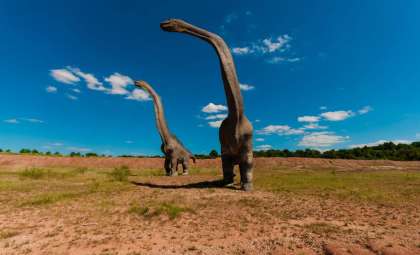
A fossil excavated in Antarctica back in 1985 has now been identified as part of a titanosaur, a category of large herbivorous dinosaurs with elongated necks. This specimen, preserved within the British Antarctic Survey archives for decades, sheds light on prehistoric ecosystems on a continent that is today blanketed by ice sheets.
The fossil, consisting of a partial tail vertebra, was found on James Ross Island during a geological expedition led by scientist Mike Thomson, who was investigating Antarctic rock formations and collecting fossils to better comprehend the continent’s ancient geological timeline.
Initially categorized as a large reptilian bone, the specimen was stored away without further examination. Years later, paleontologist Mark Evans rediscovered the fossil within the British Antarctic Survey’s collection, prompting a thorough reanalysis. Detailed studies and fossil comparisons ultimately revealed its true identity.

The results were published in the journal Acta Palaeontologica Polonica, confirming the fossil’s classification as a titanosaurian sauropod from Antarctica’s Upper Cretaceous period. This represents a rare example of dinosaur remains in the southern polar region’s sparse fossil record.
Unearthing a Rare Dinosaur Legacy Beneath Antarctica’s Ice
Fossils on Antarctica are exceptionally scarce due to the continent’s extensive ice cover, complicating exploration efforts. The newly identified remains are remarkable because they originate from a locale that was vastly unlike the icy terrain seen today.
“This discovery represents only the second sauropod body fossil known from Antarctica, although it was the first dinosaur bone to be collected from the continent,” explained the authors.
During the dinosaur’s era millions of years ago, Antarctica featured lush forests and hosted diverse life forms. It enjoyed a considerably warmer and more hospitable climate than the frigid conditions present now. Study co-author Paul Barrett of London’s Natural History Museum described the prehistoric environment as strikingly "different and far more welcoming compared to the present day."

This case highlights how fossils once considered ordinary can yield groundbreaking discoveries years later, thanks to advanced research methods and growing scientific expertise that unlock details previously unnoticed.
A Modest-Sized Titanosaur with an Enigmatic Past
Experts estimate the dinosaur measured about 7 meters (23 feet) in length. While many titanosaurs were massive, this specimen was comparatively small, possibly representing a juvenile individual.
According to the recent study, the exact species remains uncertain because only a tail fragment has been recovered. The limited fossil material prevents full reconstruction or a comprehensive understanding of its biology.

Researchers are also unsure about the circumstances surrounding the dinosaur’s death. They speculate its remains may have floated from shore into the marine environment, where they settled and fossilized within oceanic sediment. This finding provides insight into how dinosaur remains have survived Antarctica’s harsh geological conditions to appear in the fossil record today.
Cutting-Edge Techniques Reveal a Long-Buried Dinosaur Puzzle
The fossil’s identification was enabled by modern advances in paleontology, allowing scientists to examine fine anatomical features and compare them against a broad database of fossils.
When Mike Thomson discovered the bone in 1985, the analytical tools then available were insufficient for definitive identification. The fossil remained undetermined until Evans and colleagues revisited the specimen years later. Unfortunately, Evans passed away in 2020 before learning that the fossil he helped find belonged to a dinosaur.
“If he were still with us, he would be delighted to know what this was,” Evans said.
- Categories:
- Science






0 comments
Sign in to Comment