

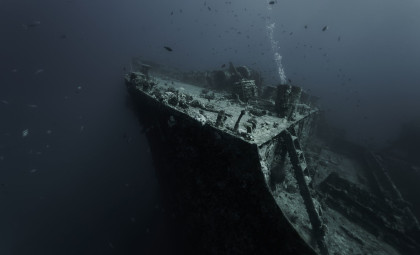
Off the southeastern coast of France near Ramatuelle, authorities have confirmed the discovery of a 16th-century trading vessel shipwreck resting at an incredible depth of about 2,567 meters beneath the Mediterranean Sea. This marks the deepest shipwreck ever documented within French maritime jurisdiction.
In late February to early March 2025, French Navy teams were exploring the seabed south of Saint-Tropez. On March 1, 2025, an underwater drone detected a previously unknown sonar target. The team captured initial photographs through the drone, followed by higher-resolution images taken using a remotely operated underwater vehicle.
The images were handed over to marine archaeologist Arnaud Schaumasse, who leads the Underwater Archaeology Division under the French Ministry of Culture. “This appears to be the largest wreck recorded in French waters,” Schaumasse said. “Though the U.S. Navy reports even larger wrecks within its own territorial waters.” French sources emphasize it is the deepest within their jurisdiction.

Underwater Sonar Reveals Uncharted Shipwreck
The discovery originated when a marine sonar specialist identified an exceptionally large unexplored sonar signature during a state-led deep-seabed monitoring mission.

Deputy Maritime Prefect Thiery De La Burgade explained, “The sonar revealed a sizeable target, prompting us to deploy a camera-equipped underwater drone for images, then an underwater robot for enhanced photos.”
Two types of underwater vehicles assisted the mission: an A-18-D Autonomous Deep-Sea Vehicle for initial survey, followed by a remotely operated vehicle (ROV) for detailed inspections.
The shipwreck’s designation, Camarat 4, reflects it being the fourth maritime heritage site registered within this zone.
Camarat 4 Yields Hundreds of Ligurian Pottery Artifacts
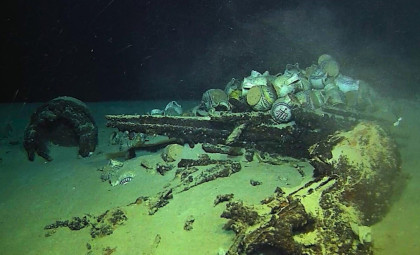
The images unveiled a significant collection of ceramics consisting of roughly 200 visible colorful earthenware jugs, with many more concealed beneath sediment. These spherical containers feature pinched spouts and ribbon handles.
Some vessels bear the Christian symbol “IHS”, others display plant motifs or geometric patterns. Scholars linked these designs to recognized 16th-century pottery from the Liguria region in modern-day northern Italy.
Also among the cargo were about 100 plates, presumed to originate from Ligurian workshops, many stacked on the ocean floor.

Metal bars were recovered as well, hinting at the vessel’s Ligurian origin, with a probable southwestern route when it sank.
Artifacts likely associated directly with the ship have been found, including two cooking cauldrons, an anchor, and six cannons. Additional structural debris remains partly buried in sediment.
Great Depth Preserves Shipwreck’s Remarkable Condition
The extraordinary depth of the Camarat 4 wreck has shielded it from human disruption for centuries. The inaccessibility prevented salvage efforts at the time of sinking and safeguarded it from later looting.
Marine archaeologist Marine Sadania remarked, “Due to its extreme depth discouraging recovery or interference, the site remains remarkably well-preserved, almost as if frozen in time, which is truly exceptional.”
Despite this, traces of modern pollution have been spotted amid the ancient relics. Cameras captured contemporary debris such as a soda can and a discarded yoghurt container.

ScienceAlert, featuring AFP reports, has also documented the presence of modern waste, the metal cargo, Sadania’s comments on preservation, and comparisons to France’s former deep-sea wreck record.
The previous depth record was held by La Minerve, a French submarine lost in 1968 off Toulon at about 2.3 kilometers underwater, with 52 sailors aboard, just minutes into a routine mission.
- Categories:
- News





0 comments
Sign in to Comment