

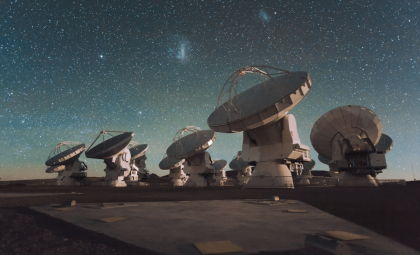
Scientists have identified the farthest very-high-energy blazar ever recorded, observing gamma rays that journeyed nearly 8 billion light-years before reaching our planet. This groundbreaking discovery, published in Astronomy & Astrophysics, resulted from collaborative observations using the Large-Sized Telescope LST-1 and the MAGIC telescopes at the Roque de los Muchachos Observatory on La Palma, Spain.
The extraordinary source, labeled OP 313, is an active galaxy boasting a supermassive black hole at its core that propelled highly energetic particles across immense distances. Capturing this signal grants astronomers a rare glimpse into the universe as it existed roughly 11 billion years ago, during the so-called cosmic noon—a peak era of star formation in galaxies.
Breaking Records from the Peak Epoch of Galaxy Formation
The detection of OP 313 originated from observations in December 2023, when the prototype LST-1 spotted the distant blazar emitting very-high-energy gamma rays. Subsequent joint analysis with the MAGIC telescopes confirmed its unrivaled status as the most distant very-high-energy blazar observed.

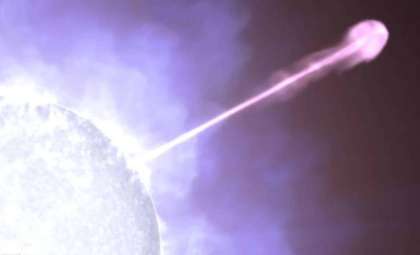
This blazar falls into the category of flat-spectrum radio quasars, among the brightest active galactic nuclei. Such objects harbor massive black holes accreting matter and creating plasma jets extending thousands of light-years. When these jets align with Earth, the emitted radiation appears significantly amplified.
The gamma-ray burst from OP 313 was emitted when the universe was transitioning from its period of rapid galaxy evolution. At that time, roughly 11 billion years ago, cosmic structures were rapidly developing, shaping the galaxies we observe today.
The gamma-ray photons detected by LST-1 and MAGIC started their voyage when the cosmos was much younger. Their arrival offers researchers a unique perspective to study the blazar and the intergalactic medium through which the rays have traveled.

Gamma Rays Illuminate Extragalactic Background Light
The findings reported in Astronomy & Astrophysics also shed light on the extragalactic background light (EBL)—a faint glow composed of cumulative starlight, galactic emissions, and other cosmic radiation throughout the universe’s history.
As very-high-energy gamma rays traverse space, they interact with this background radiation. These interactions can convert gamma photons into electron-positron pairs, diminishing the quantity of high-energy photons that ultimately arrive on Earth. This mechanism makes observing distant gamma-ray sources increasingly challenging.

By analyzing OP 313’s signal, researchers have imposed tighter constraints on the density of the extragalactic background light, improving our understanding of how much energy was absorbed en route. These insights enhance models of galactic light evolution over billions of years.
The results highlight the importance of integrating data from various observatories. While LST-1 and MAGIC supplied high-energy gamma-ray observations, lower-energy data from other telescopes contributed to a comprehensive characterization of the blazar’s activity.
Jet-Driven Energetic Emission from a Supermassive Black Hole
The study reveals that the intense gamma-ray radiation recorded from OP 313 likely originated from highly accelerated electrons within the blazar’s relativistic jet. These charged particles reached speeds close to light, energized by processes near the central black hole.
This explanation aligns with a leptonic scenario, wherein electrons upscatter ambient lower-energy photons to gamma-ray energies by transferring kinetic energy during collisions.
Deciphering the mechanics of these jets remains a fundamental puzzle in astrophysics. Although supermassive black holes discharge immense power, the acceleration mechanisms producing extreme gamma-ray emission are not yet fully understood.
The observations of OP 313 offer a rare opportunity to explore physics in black hole surroundings that cannot be replicated anywhere in our solar system, by probing light emitted from a galaxy billions of light-years away.

LST-1 Heralds a New Era in Gamma-Ray Astronomy
This achievement marks a significant development for the LST-1 telescope, the prototype of the Large-Sized Telescope array being constructed for the Cherenkov Telescope Array Observatory. Although still in its commissioning phase at the CTAO-North site in La Palma, LST-1 has showcased its capacity to detect some of the most distant gamma-ray sources to date.
The forthcoming LST network aims to enhance sensitivity to gamma rays with energies down to about 20 GeV, enabling the study of sources previously inaccessible to current very-high-energy instruments.
Expanding the LST system by adding telescopes at La Palma will open new avenues to explore remote galaxies, relativistic jets, and other extreme cosmic phenomena. Enhanced sensitivity is expected to extend the observable gamma-ray horizon, unveiling further interior details of the early universe.
Detecting OP 313 underscores how swiftly gamma-ray astronomy is progressing, with even prototype instruments pushing the frontiers of observable cosmic distances.
Unveiling the Universe’s Ancient Energetic Phenomena
The observation of OP 313 merges several branches of astrophysical research, connecting black hole physics, galaxy evolution, and the cosmic radiation background. This single gamma-ray signal offers insights into a galaxy from the distant past while illustrating the evolution of radiation throughout cosmic history.
Future detections using advanced gamma-ray observatories could reveal more distant blazars and provide a clearer understanding of energetic processes in the early cosmos. Each discovery expands our glimpse of extreme environments far beyond our local neighborhood.
The record held by OP 313 is not merely about distance—it opens a novel window to investigate the universe’s most powerful engines and the subtle phenomena occurring in the voids between galaxies.
- Categories:
- News









0 comments
Sign in to Comment