

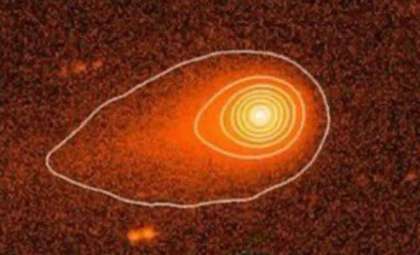
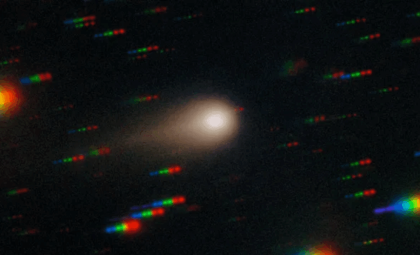
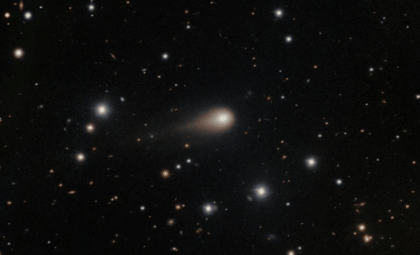
Recent studies reveal that 3I/ATLAS, the third interstellar object detected passing through our solar system, originated in an extremely cold zone around a distant star. Research published in the Monthly Notices of the Royal Astronomical Society indicates that this comet-like traveler bears a chemical fingerprint suggesting its formation in a frigid, remote region far from its parent star. By analyzing gases emitted as the object journeyed away from the sun, scientists uncovered environmental conditions unlike those found in typical solar system comets. This discovery offers a unique chance to examine material that has voyaged across interstellar space for millions of years before reaching our galactic neighborhood.
Peering into Another Star's Planetary System
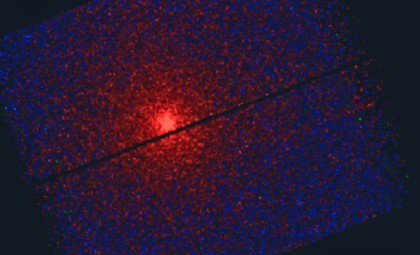
The detailed investigation of 3I/ATLAS was led by Dr. Lea Ferellec, a research fellow at Northumbria University’s School of Engineering, Physics and Mathematics. She and her team studied the ionized gases escaping from the comet as it traveled through space. Utilizing the Large Integral Field Unit (LIFU) mode of the WEAVE spectrograph on the William Herschel Telescope—which is operated by the Isaac Newton Group—they observed the object with unprecedented precision.
Employing sophisticated imaging spectroscopy alongside new tracking technology designed for fast-moving targets, the researchers simultaneously detected five different ions in the comet’s gas envelope. This level of chemical insight is rare even for solar system comets and represents a pioneering achievement for an interstellar entity. Their focus on measuring the ratio of dinitrogen gas to carbon monoxide allowed them to infer the cold formation environment of 3I/ATLAS.


Findings suggest that 3I/ATLAS formed in regions colder than -240°C (-400°F), indicative of a birthplace in a far-flung, icy zone within another star system. Such environments mirror the outer cold areas around young stars where icy bodies can coalesce, shielded from intense heat and radiation.
Reflecting on the discoveries, Ferellec commented,
“This object gives us a rare chance to study material that formed somewhere completely different from our own solar system. Finding that it’s so rich in nitrogen tells us it likely formed in extremely cold conditions, far from its home star. Every one of these objects we study helps us understand a little more about how planets form around other stars.”
Decoding the Chemical Signals of a Visitor from Beyond
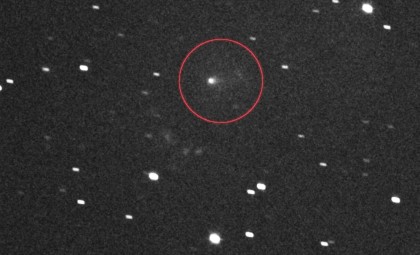
Interstellar objects like 3I/ATLAS are exceptionally uncommon astronomical finds, as they originate from star systems outside our own before crossing vast interstellar distances. To date, only three such bodies have been confirmed, with 3I/ATLAS spotted in July 2025 during its passage through the inner solar system en route back into deep space.
Dissimilar to native solar system comets, these visitors act as carriers of chemical information from alien planetary nurseries. Their distinct compositions provide scientists with a means to compare planetary formation processes across different stellar environments, revealing whether these processes share universal traits throughout the galaxy.

The research published in Monthly Notices of the Royal Astronomical Society highlights how nitrogen-rich molecules serve as clues to the comet’s formation conditions. A substantial abundance of dinitrogen strongly suggests that the object originated in a cold environment where such volatile compounds could remain intact before becoming an interstellar wanderer.
Although the exact star system that birthed 3I/ATLAS remains unidentified, the findings narrow down its likely formation setting to an isolated, frozen region in another planetary system. The object’s early life was probably spent in these remote icy outskirts before being cast into interstellar space, where it drifted for millions of years prior to its encounter with our solar neighborhood.
Tracking Ion Variations Along the Comet’s Tail
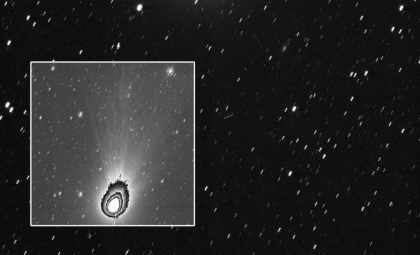
The international team, including researchers from the University of Edinburgh, also monitored changes in ion composition along 3I/ATLAS’s tail. A comet’s tail forms when solar radiation and charged particles interact with material escaping from its nucleus, creating a trailing plasma stream stretching into space.
These observations offered an unprecedented perspective on how ion populations shift along the tail of an interstellar visitor. Documenting ion behavior in this way provides fresh insights into how objects from other systems respond to new stellar environments.
Such detailed studies were made possible by the sensitivity of WEAVE-LIFU, capable of gathering extensive spectral data across wide fields while tracking faint, fast-moving targets. This technology opens avenues for exploring difficult-to-observe objects with high scientific impact.
“Powerful, large-format IFUs with high sensitivity in the blue optical spectrum—like WEAVE-LIFU on the WHT—are opening new frontiers for the study of comets and other solar system objects,” said ING Director Rubén Sánchez-Janssen. “This discovery is a perfect example of the value of DDT, which is specifically designed to enable observations of exceptional and urgent scientific importance.”

Insights into Planet Formation Beyond Our Sun
The analysis of 3I/ATLAS enriches understanding of how planetary systems develop outside our solar neighborhood. Each interstellar object studied offers a glimpse into material formed under different cosmic conditions, allowing astronomers to contrast these distant origins with our solar system’s evolutionary history.
As observational technology advances, enabling detection and detailed study of more such rare visitors, scientists anticipate new revelations about the chemical makeup, birth environments, and interstellar journeys of objects moving between star systems. For now, 3I/ATLAS remains a vital messenger carrying direct evidence from planets formed around another star.
- Categories:
- News




0 comments
Sign in to Comment