

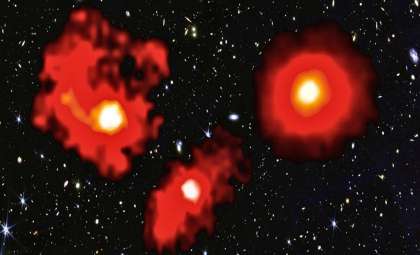
The James Webb Space Telescope has transformed our understanding of two enigmatic distant objects, revealing they are not dim quasars as once thought, but instead exceptionally bright galaxies experiencing vigorous star formation bursts. This finding uncovers a hidden group of extreme starburst galaxies and highlights the challenges in distinguishing young galaxies from black hole-driven sources.
Captured from a time when the universe was under one billion years old, these galaxies host some of the most massive stars ever observed at such distances. Understanding the nature of luminous distant objects remains difficult for astronomers studying the universe’s first billion years, as galaxies emitting intense ultraviolet light and faint black hole-powered quasars can appear very similar in limited observations.
Both category types often exhibit blue ultraviolet spectra and strong hydrogen Lyman-alpha emissions, complicating efforts to differentiate them using traditional observational methods. This ambiguity influences estimates of the number of early quasars and starburst galaxies.

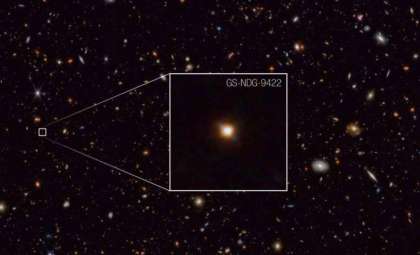
Led by Sarah E. I. Bosman of Leiden University, the research team reexamined two objects, J1450−0144 and J1429−0104, initially categorized as faint quasars in the Subaru High-z Exploration of Low-Luminosity Quasars (SHELLQs) survey. As outlined in a study on the arXiv preprint server dated Aug. 18, detailed data from JWST and ALMA confirmed these sources as Extreme UV Luminous Galaxies (EUVLGs).
JWST Unveils Signs of Enormous Stars
Using JWST’s NIRSpec, scientists analyzed the emitted light from these far-off galaxies and identified spectral features tied to intense stellar processes, rather than active black hole accretion. This new evidence reshaped our view of these objects previously misclassified.
A critical indicator was the presence of P Cygni profiles—spectral patterns linked to strong stellar winds from massive stars. These features are signature marks of radiation-driven winds and are inconsistent with quasar characteristics.

Moreover, the telescope detected exceptionally strong broad helium emissions. As detailed in the study, models with stars capped at approximately 100 solar masses failed to replicate this signal’s strength. Accurate modeling required the presence of stars exceeding 100 times the Sun's mass.
Estimates suggest these galaxies are generating stars at staggering rates, ranging from 300 to 540 solar masses annually. Each galaxy may hold between 100,000 and one million extremely massive stars, though precise mass thresholds are uncertain due to current models being based largely on nearer Milky Way stars rather than primordial early-universe conditions.
ALMA Data Supports Intense Early Star Formation
Combining spectroscopy from JWST with measurements from the Atacama Large Millimeter/submillimeter Array (ALMA) offered an in-depth view of the young stars emitting ultraviolet light alongside the cooler gas and dust surrounding these galaxies. This data fusion helped clarify the ongoing energetic processes.
Both galaxies showed strong emissions in the [C II] line and from cold dust. Narrow spectral lines of oxygen and neon indicated the incident radiation was from young stars illuminating the surrounding gas, not from a central black hole.
Additionally, the absence of broad Lyman-alpha and Mg II emission lines indicated these bodies were not quasars but rather matched the spectral profile of Extreme UV Luminous Galaxies, leading to the reclassification of J1450−0144 and J1429−0104.
These findings mark the first bright galaxies from such an early cosmological era to be spectroscopically verified, suggesting some previously identified faint quasars might actually be powerful starburst galaxies.
An Unusual Displacement of Light and Matter
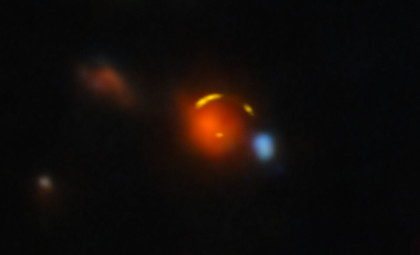
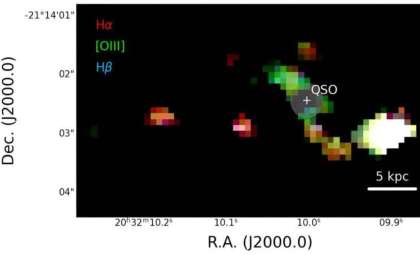
Researchers observed a striking spatial offset in J1429−0104, where ultraviolet emissions do not coincide with the dust and gas locations. The displacement measures approximately 17,600 light-years.
The cause for this separation remains unknown but could stem from galaxy mergers, centrally obscured starburst activity, or feedback mechanisms expelling dust from portions of the galaxy.
According to the team, these objects align with the EUVLG group, offering exceptional opportunities to investigate intensely star-forming, compact, gas-rich galaxies in the early universe. Their work sheds light on compact systems comprising vast numbers of extremely massive stars.
“Taken together, these results identify J1450−0144 and J1429−0104 as a new class of laboratories at the very bright end of the UVLF at high redshift: compact, gas-rich, intensely star-forming galaxies that simultaneously host substantial very massive star populations,” the researchers conclude.
- Categories:
- Astronomy


0 comments
Sign in to Comment