

Scientists utilizing the James Webb Space Telescope have discovered a distant celestial entity that may be the inaugural example of a novel category known as a black hole star. This object dates back to approximately 660 million years post-Big Bang and exhibits traits inconsistent with typical stars.
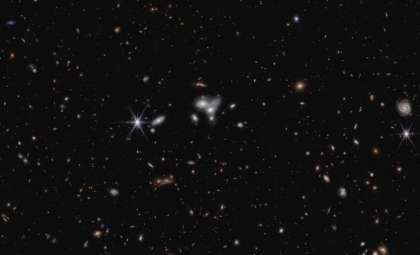
The breakthrough came courtesy of a team from MIT while surveying the universe's earliest galaxies as part of the Mirage or Miracle survey. The object, dubbed MoM-BH*-1, was identified in one of Webb’s deepest field observations and has sparked considerable intrigue due to its unusual characteristics from the early universe.
At first glance, MoM-BH*-1 appeared as an intense red point of light with an extraordinary color signature. It was nearly undetectable through Webb’s blue filters but shone brightly in the red spectrum, ranking it among the reddest faraway sources ever observed.

Subsequent spectroscopic studies distinguished MoM-BH*-1 by revealing remarkable features. As reported in Nature, it presented the strongest Balmer break ever detected at any redshift, signaling extremely dense hydrogen gas in its environment.
Unexplainable Light Characteristics for a Normal Star
The extraordinary Balmer break signal detected in MoM-BH*-1 challenges current astrophysical models. Although this break is linked to hydrogen absorption, its intensity surpasses what any conventional star or known stellar population could generate. In fact, even the reddest recognized star groups show breaks less than a third as strong as that seen here. The spectral data also displayed broad hydrogen emission lines coupled with deep absorption features, indicative of a dense gaseous environment.
Additionally, the elemental makeup of MoM-BH*-1 is peculiar. The team found scant evidence of metals or heavier elements, with spectra dominated almost exclusively by hydrogen and helium. Rohan Naidu from MIT emphasized that the observed depth of the break rules out ordinary stars as the light source.

While initially considering a unique type of stellar atmosphere, the team found that the radiation output of MoM-BH*-1 far exceeds levels achievable by nuclear fusion in any star of comparable size, demanding an alternative explanation.
A Black Hole Enshrouded in Thick Hydrogen Gas
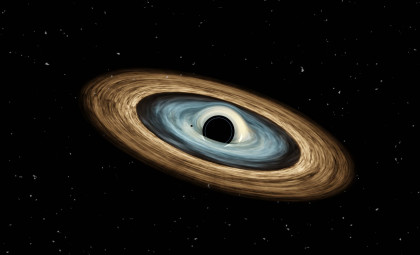
Researchers propose that MoM-BH*-1 houses a supermassive black hole enveloped by a dense, turbulent shell of hydrogen gas, creating the illusion of a massive, star-like object.
They estimate the central black hole's mass lies between 100,000 and 10 million solar masses. The surrounding gas shell could span from 10 to 100 astronomical units, approximately the diameter of the Solar System. Radiation from the black hole’s accretion disk would traverse this gaseous cocoon, causing absorption and scattering effects that result in its distinctive red hue and unusual spectral features detectable by Webb.

The model does not rely on dust to explain observations. Instead, the dense hydrogen envelope around the black hole suffices. The paper published in Nature also notes possible brightness fluctuations of roughly 30% over two months, consistent with a growing black hole feeding on nearby material.
The Mystery of the Little Red Dots
MoM-BH*-1 might be a member of the elusive category known as little red dots. These enigmatic sources are frequently detected in the early universe but appear to have vanished in later epochs.
The scientists suggest that a supermassive black hole cloaked by an extended gas atmosphere creates the star-like appearance of these systems, potentially explaining many unusual red objects discovered by Webb.
“We think there is a central black hole that is 100,000 times as massive as the Sun,” Naidu said “And around this black hole, there would be this very extended envelope of gas that looks like a star the size of the Solar System. It’s huge.”

- Categories:
- Astronomy


0 comments
Sign in to Comment