

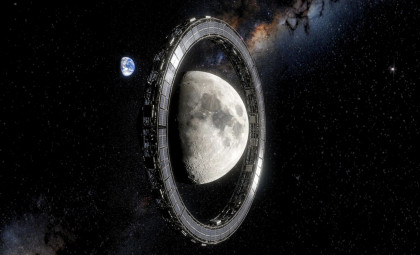
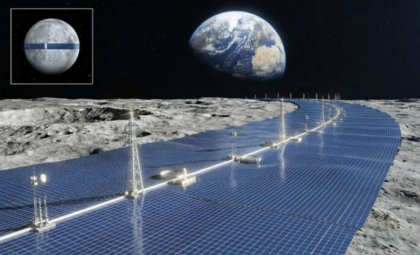
Envision a sprawling ring of solar panels wrapping around the Moon’s equator, extending roughly 11,000 kilometers (6,800 miles) in length and reaching widths up to 400 kilometers in certain areas. This lunar array would gather solar power and transmit it to Earth via microwave and laser technology.
Japanese engineering firm Shimizu Corporation has dubbed this ambitious initiative the Luna Ring. The plan integrates lunar-based solar arrays, power transmission cables, relay stations, terrestrial receiving setups, and autonomous robotic assemblers.
The Luna Ring proposal along with its project brochure set out an extensive timeline, projecting construction commencement around 2035. Tetsuji Yoshida, then head of the space consulting group CSP Japan under Shimizu, revealed in 2011 that the concept had been introduced a year earlier.

A Solar Array Encircling the Lunar Equator
The design positions solar panels along the Moon’s entire equatorial band, varying from a narrow strip to 400 kilometers wide at maximum. Adjacent power cables would transport the harvested energy.
Energy collected would flow through these conductors to transfer hubs located on the Moon’s Earth-facing hemisphere, enabling constant solar power generation free from terrestrial weather disruptions.
The system envisions energy transmission through both microwave and laser beams. Notably, antenna dishes measuring 20 kilometers across would be tasked with focusing microwave signals, using Earth-based guide beacons for precision targeting. An additional laser transmission mechanism would also depend on Earth-located beacons for accurate alignment.

On the terrestrial side, rectenna arrays would intercept the microwave emissions and convert them into direct current electricity. Facilities dedicated to laser reception would perform a similar function for the laser-transmitted power. This energy could then feed into electrical grids or be converted to hydrogen fuel for storage and usage.
Back in 2011, Yoshida pointed out to ABC News that solar panels on Earth produce only about one-twentieth the energy of those in space under ideal conditions due to atmospheric interference and weather, whereas the Moon receives uninterrupted sunlight.
Construction Strategy: Robotics and Lunar Materials
The plan relies heavily on utilizing lunar regolith as raw material to manufacture ceramics, concrete, glass, and solar panels, alongside vital resources like oxygen and water. Hydrogen will be transported from Earth to assist in creating water from lunar compounds.
Autonomous robots controlled remotely from Earth would undertake much of the groundwork, including excavation and site preparation, while a limited number of astronauts would cooperate directly on the Moon.
Some equipment would be launched from Earth, assembled in orbit, then delivered to the lunar surface. Along the equator, the team envisions a transport corridor embedded with power lines beneath. Mobile, automated factories would traverse this path, producing and deploying solar cells made from moon-derived materials.

According to Shimizu, research and technology development phases were assigned to the 2010s, experimental demonstrations on Earth and lunar tests to the 2020s, with preparatory work for actual Luna Ring construction in the 2030s, targeting a 2035 launch.
Financial and Timeline Challenges Remain
In 2011, ABC News reported that Yoshida did not have precise cost estimates or a fixed schedule for the Luna Ring. He noted construction might start by 2035 if sufficient investment was secured.
Meanwhile, experts like Masanori Komori from Japan’s Institute of Energy Economics expressed skepticism regarding the project’s financial feasibility, advocating for alternatives with nearer-term potential. “Lunar solar power remains mostly experimental,” Komori remarked to ABC News.
Interest in the concept grew after the March 11, 2011 earthquake and tsunami devastated the Fukushima Daiichi nuclear facility. At that time, Japan had 54 nuclear reactors supplying about 30% of its electricity, but many were offline due to safety issues. Yoshida mentioned that the lunar project garnered increased attention after a quiet period following this disaster.
Shimizu’s Luna Ring proposal features an equatorial solar band nearly 11,000 kilometers long, with widths varying up to 400 kilometers, combined with microwave antennas spanning 20 kilometers in diameter and a separate laser energy transmission system aimed at Earth-based receivers.



0 comments
Sign in to Comment