

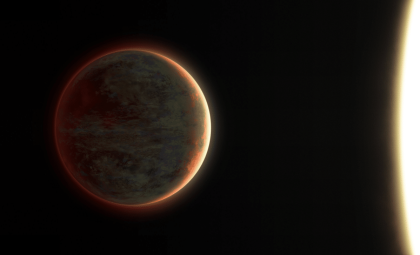
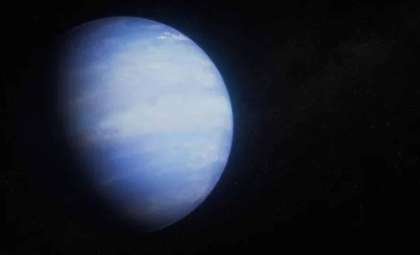
The James Webb Space Telescope (JWST) has potentially identified semi-heavy water in the atmosphere of WASP-39b, a massive exoplanet situated nearly 700 light-years from Earth. WASP-39b stands out as one of the exoplanets with the most detailed investigations by JWST, which has gathered extensive data using infrared observations from all four of its primary instruments.
These observations enable scientists to analyze the chemical signatures found in exoplanetary atmospheres. Examining the starlight filtering through the atmosphere reveals the presence of specific molecules and provides insights into the planet's formation and evolution.
Water remains a particularly intriguing molecule, as it offers clues about planetary conditions. In this research, the emphasis was placed on an uncommon variant known as semi-heavy water or HDO.

Discovery of a Unique Water Signature on WASP-39b
The study team, whose findings are shared on the preprint platform arXiv, concentrated on water isotopologues—molecules similar to regular water but containing different isotopes of hydrogen. In particular, HDO includes one hydrogen atom replaced by deuterium, a heavier isotope that carries an extra neutron. This replacement allows astronomers to calculate the deuterium-to-hydrogen (D/H) ratio, which can provide clues about the origin of a planet’s water and atmospheric changes over time.
Researchers matched simulation models of WASP-39b’s atmospheric conditions against the actual JWST data. They evaluated factors such as temperature, cloud cover, molecular concentrations, and how the atmosphere absorbs light.

The data indicates that WASP-39b’s D/H ratio is significantly elevated compared to gas giants within our solar system, suggesting new perspectives on water dynamics in exoplanet atmospheres.
WASP-39b was selected in part due to the wealth of existing observational data. The team emphasized that JWST has delivered the most comprehensive transmission spectrum ever recorded for a distant planet, offering unprecedented detail about its atmosphere.
Harsh Conditions Altering the Planet’s Water
The peculiar water composition might stem from WASP-39b’s extreme environmental conditions. This hot, low-density gas giant orbits very close to its star, subjecting its atmosphere to strong stellar radiation.
One hypothesis is atmospheric escape, where lighter water molecules containing normal hydrogen are more easily lost to space, leaving behind a relative excess of heavier, deuterium-containing water molecules. This process could gradually increase the semi-heavy water concentration.

Additional atmospheric dynamics, such as chemical reactions stimulated by stellar radiation and atmospheric mixing, could also affect the observed D/H ratio detected by JWST.
The exact cause of WASP-39b’s unique water signature remains uncertain. The observational results offer a detailed chemical snapshot, but multiple processes may contribute to these findings.
Insights into the Planet’s Formation from Its Water Signature
Another theory suggests WASP-39b may have originally formed farther from its star in a colder part of the system beyond the snow line. In this scenario, the planet would have accrued water-rich ice and materials from this distant region before migrating inward to its current orbit.
“Observations of protostellar ices from this region that show a degree of deuterium-enrichment consistent with the D/H ratio inferred from WASP-39 b,” explained the authors. They also added that “determining whether this scenario could produce the observed values requires detailed chemical modeling.”
WASP-39b is inhospitable for life as we know it, with surface temperatures nearing 1,000 degrees Celsius (1,832 degrees Fahrenheit). Nevertheless, identifying HDO illustrates JWST's power to reveal complex details about atmospheric chemistry on distant worlds.

The scientists highlight that semi-heavy water is one of the clearest chemical indicators for studying planetary water because it generates unique spectral features visible even at vast distances.
- Categories:
- Astronomy











0 comments
Sign in to Comment