

Recent data from the James Webb Space Telescope (JWST) indicate that Neptune’s diminutive moons and rings might be composed of debris from primordial satellites that were obliterated when Triton was captured. Neptune’s satellite system is unique among the gas giants; unlike Jupiter and Saturn, which boast numerous major moons, Neptune’s satellite mass is almost entirely concentrated in a single moon—Triton—accounting for over 99% of the combined mass.
Triton’s orbit is particularly peculiar as it moves retrograde, opposite to Neptune’s rotation, which supports the theory that it originated in the Kuiper Belt and was later gravitationally ensnared by Neptune rather than forming in place.
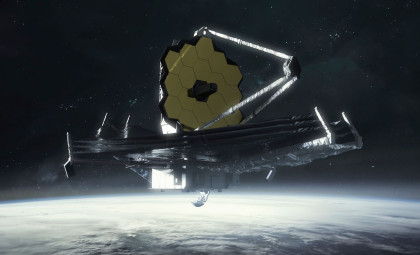
A groundbreaking investigation published in Science Advances utilized JWST’s Near-Infrared Spectrograph (NIRSpec) to scrutinize the smaller moons and rings encircling Neptune. The findings imply these bodies contain materials from larger, ancient satellites that have long since vanished.

JWST Detects Unexpected Minerals on Neptune’s Minor Satellites
The team identified the presence of magnesium-rich phyllosilicates on two of Neptune’s lesser moons, Larissa and Galatea, as well as within the planet’s rings. These minerals typically signify chemical interactions between rock and liquid water.
This discovery is surprising because the surfaces of these moons are currently too cold to support liquid water. Moreover, the researchers found no evidence of water ice associated with these minerals, which suggests the materials originated elsewhere before settling here.

According to the scientists, these phyllosilicates likely formed within larger icy bodies where internal heating enabled water-rock chemical processes. Essentially, these minerals may trace back to the inner layers of original moons rather than the present small satellites.
The research notes that the mineral composition resembles substances found on Ceres and certain large asteroids in the main belt. This supports the idea that Neptune’s ancient moons could have been sufficient in size to undergo internal differentiation, akin to other known celestial bodies.
Triton’s Capture Shattered Neptune’s Early Moons
Current theory suggests that Triton’s capture severely disrupted Neptune’s primordial moon system. As a Kuiper Belt object arriving at Neptune, Triton likely wrecked or fragmented the original moons.
The study proposes that Neptune’s current inner moons may be the reassembled fragments of these shattered bodies, with their distinct minerals offering direct insights into the interiors of lost satellites.

The authors highlight that these moons might provide a unique window into the internal composition of an icy satellite or even a dwarf planet, depending on the timing of the mineral transformations.
This framework also clarifies why Neptune’s satellite system currently appears so distinctive, possibly bearing only fragments from the original moon assembly alongside the massive captured Triton.
Nereid Offers Clues About Neptune’s Past Moons
Another hypothesis considered is that a different substantial Kuiper Belt Object could have been destroyed near Neptune, depositing the magnesium-rich minerals. However, researchers find this scenario less plausible. Data from Nereid, Neptune’s third-largest moon, provides contrasting evidence. The study reveals that Nereid’s near-infrared signature is dominated by crystalline water ice, inconsistent with any known Kuiper Belt objects or typical irregular satellites.
“Companion JWST observations of Nereid—Neptune’s third-largest moon, historically classified as an irregular satellite—provide independent evidence that a primordial regular satellite system existed around Neptune before Triton’s capture. Nereid’s near-infrared spectrum is dominated by crystalline water ice and is inconsistent with the spectrum of any observed KBO or irregular satellite,” the team explained.

Continued investigations into Neptune’s minor moons are expected to unveil further information about these ancient remnants. Concealed within these small bodies may lie vestiges of a lost cohort of moons predating Triton’s capture.
- Categories:
- Science



0 comments
Sign in to Comment