

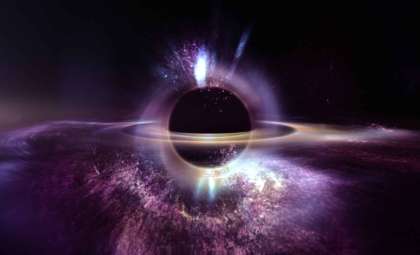
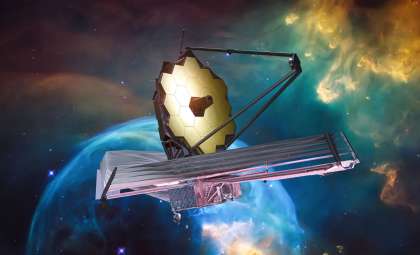
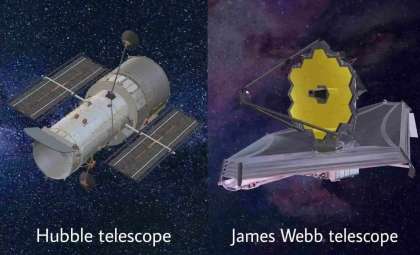
Researchers may have discovered the earliest example of a “black hole star,” a rare phenomenon where a swiftly growing black hole is encased in a dense, dust-free gas shell. This remarkable object, observed just 660 million years post-Big Bang, could shed light on how colossal black holes formed so soon after the universe’s birth. The findings, published in Nature, also hint at a link between these entities and the enigmatic “little red dots” frequently detected by the James Webb Space Telescope (JWST).
Witnessing a Black Hole from the Universe’s Early Days
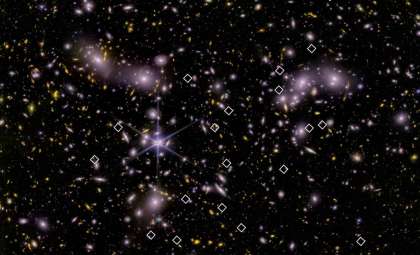
The celestial body, named MoM-BH-1, came to light through the Mirage or Miracle initiative, a global collaboration focused on exploring unusual objects in JWST’s deep universe surveys. Its light’s journey spanned approximately 13 billion years, offering astronomers a glimpse into the universe’s formative era.
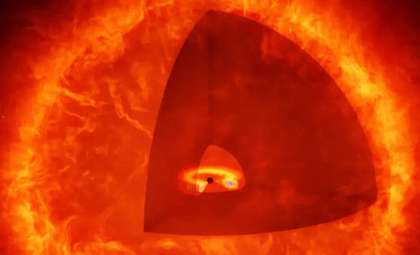
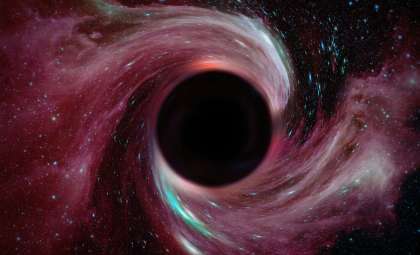
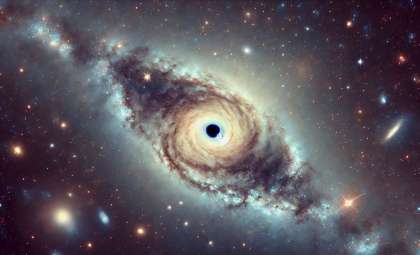
Central to the discovery is a rapidly feeding black hole enveloped by gas rather than thick dust. Unlike typical scenarios obscured by dust, this black hole is surrounded by a pure gaseous shell that influences the color and spectral qualities of its emitted light. This environment provides astronomers with a rare opportunity to observe the black hole’s core directly, without significant interference from its host galaxy.


This breakthrough addresses a fundamental puzzle in astrophysics. Early quasars have been found hosting black holes with masses ranging from millions to billions of solar masses, despite the universe being less than a billion years old at the time their light was emitted. Traditional growth theories have difficulty explaining how these behemoths formed so quickly.
“Until now, we have known very little about how these supermassive black holes formed. In addition, some quasars found in the early universe seemed far too massive to exist, which led astronomers to call them ‘problematic quasars,’” says Jorryt Matthee, assistant professor at the Institute of Science and Technology Austria.
While this discovery does not entirely solve the mystery behind the birth of the universe’s earliest supermassive black holes, it offers a tangible example of a black hole thriving within an environment conducive to rapid growth. This positions MoM-BH-1 as an important test case for black hole formation theories during the cosmic dawn.
Decoding the Spectral Signature
Key insights emerge from the object’s spectrum, which reveals hallmarks of both an active black hole and stellar populations. A notably pronounced Balmer break stands out, typically linked to stars and stellar clusters.
In the case of MoM-BH-1, this spectral jump is more prominent than usually observed in star-forming galaxies, dust-free stellar groups, or in the puzzling little red dots. This unusual blend of features shows traits of a fast-accreting black hole combined with those expected from stars.
This unique signature underpins the researchers’ classification of the object as a black hole star. This term refers to an early evolutionary phase where a growing black hole is embedded within a compact, dense gas cloud, giving the whole system a star-like appearance.

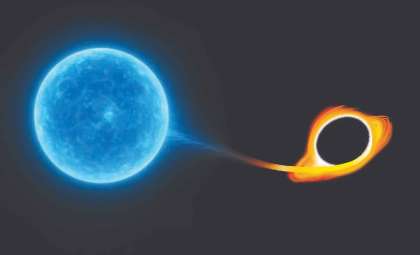
The team’s models depict the source as a smaller-scale version of a forming supermassive black hole surrounded by chaotic gas. Under favorable circumstances, black holes can ingest matter faster than the classical Eddington limit—a process described as super-Eddington accretion. This rapid feeding might explain how modest black holes balloon to the vast sizes seen in early quasars.
“Astronomers have never lacked imagination: since the discovery of quasars, there has been no dearth of theories to explain how these black holes grew so massive so fast,” says Rohan Naidu, assistant professor at the University of Hawai‘i’s Institute for Astronomy. “Something spectacular must have happened in the early universe. Now with JWST, we can directly observe this era and see for ourselves which scenarios actually occur.”
This observation offers unique empirical data for a realm previously accessible mostly through theory—a direct spectrum from an object dating to when the first supermassive black holes began to take shape.
Black Hole Stars: A Key to the Little Red Dots?
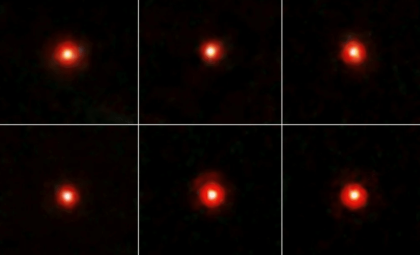
The discovery also touches on a longstanding enigma unveiled by JWST. Since its mission commenced, astronomers have noticed hundreds of tiny, distinctly red objects known as little red dots, whose nature remains unclear due to complex light mixing from active black holes and their host galaxies.
MoM-BH-1 provides a less complicated case as its emission seems almost entirely from the black hole star itself, with minimal influence from a surrounding galaxy. This clarity permits an unambiguous study of the central source.
The object’s reddish hue appears to result not from dust obscuration, as previously hypothesized for little red dots, but from light scattering and absorption in a dense gaseous envelope around the black hole. This process shifts the emitted light toward redder wavelengths while still enabling direct observation.

Researchers explored the scenario where a black hole star merges with a galaxy, as MoM-BH-1 resides near a significantly brighter galaxy expected to combine within about 100 million years. When their spectra merge, the resulting signal strongly resembles the little red dots.
This suggests a potential origin for these elusive sources: some may harbor black hole stars at their core, with their accompanying galaxies contributing additional light. While this does not imply all little red dots share this nature, it establishes a testable model for future study.
“The Mirage or Miracle survey was designed specifically to target sources considered ‘risky,’ meaning they could either be amazing discoveries or just interlopers, such as some cold nearby stars that look like distant galaxies. The survey also yielded the most distant galaxy ever confirmed, MoM-z14,” Matthee explains.
Published in Nature, this study contributes to the growing understanding of early massive black holes and the physical nature behind the little red dots detected by JWST.
- Categories:
- News


0 comments
Sign in to Comment