

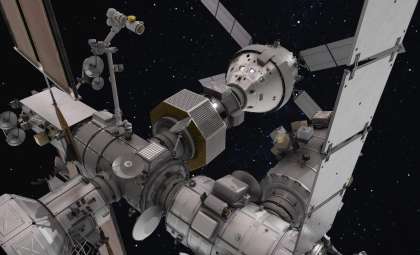
Located almost 240,000 miles from Earth, a team of engineers has crafted an innovative orbital traffic system that may revolutionize lunar missions. Researchers from Texas A&M University, NASA’s Johnson Space Center, and Purdue University have devised mathematical models to govern spacecraft movements around the Gateway lunar outpost.
A Spaceport Without Physical Infrastructure
Although Gateway won’t resemble a conventional airport, its functioning demands meticulous coordination akin to air traffic control. Instead of visible runways, spacecraft will traverse invisible routes shaped by the gravitational pulls of the Earth, Moon, and outer space. Upcoming missions may involve Orion crew vehicles, robotic freight shuttles, and oversized lunar landers arriving asynchronously within the same orbital space. Engineers are tasked with establishing safe holding zones for spacecraft awaiting docking or departure maneuvers, aiming to create predictable operational patterns near the station.
This research outlines strategies to help spacecraft stay nearby without immediate rendezvous, minimizing uncertainties amid periods featuring multiple active vehicles close to Gateway. Thousands of simulations incorporating realistic factors such as navigation inaccuracies and propulsion variabilities helped compare orbiting methods. The findings indicate that deliberate orbital spacing enhances safety and reduces fuel consumption, laying the groundwork for managing increasingly busy lunar traffic.

“The future of lunar exploration depends as much on the traffic management as it does on the rocket science,” said Dr. Diane Davis, associate professor of space engineering at the Texas A&M University College of Engineering, and an author of the study.

Distinctive Orbit Enabling Lunar Station Operations
The complexity arises from Gateway’s designated orbit—a Near Rectilinear Halo Orbit (NRHO)—an elongated lunar path leveraging Earth and moon gravitational forces. This trajectory swoops close to the moon’s north pole before extending far beyond its southern hemisphere, offering robust communication links and minimal propulsion requirements for station maintenance.
“The Gateway NRHO is a nearly stable and highly elongated orbit around the moon that provides an uninterrupted line of sight for communications to Earth and requires little propellant to maintain,” Davis said.
However, the very qualities that make NRHO efficient add operational challenges. Gravitational fluctuations continually affect spacecraft paths, so even minor timing or positioning differences can grow over time. While a single spacecraft can manage stability with occasional adjustments, coordinating multiple vehicles arriving simultaneously demands precise planning. Published in Acta Astronautica, the paper proposes how upcoming missions can maintain safe separations while ensuring operational efficiency.
The approach balances caution and productivity, recognizing that spacecraft cannot remain stationary like terrestrial aircraft parked at gates. Instead, they must follow calculated trajectories to await docking windows. The research explores maintaining ordered spacecraft groups to support consistent lunar transit schedules.

Holding Patterns Forming ‘Strings of Pearls’ in Lunar Orbit
The concept of spacecraft loitering forms a cornerstone of this research, enabling vehicles to hold positions near their orbital target as they await instructions. This strategy could become essential in managing staggered lunar arrivals and complex transfer procedures.
“Loitering in space means maintaining a spacecraft relative to a specific orbit or trajectory without executing an immediate maneuver,” Davis explained.
Analogous to aircraft holding patterns, spacecraft must maintain safe distances while constantly moving along orbital paths—making coordination substantially more intricate. To tackle this, researchers have developed schemes allowing vehicles to stay close to Gateway, mitigating risks of hazardous approaches.
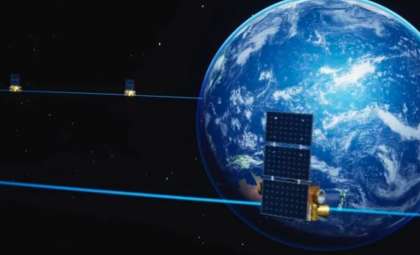
Simulations demonstrated that spacecraft could arrange themselves into a "string of pearls" formation, spaced along lunar orbits at precise points. This orderly sequence would enable mission control to accurately forecast vehicle locales and optimal times for station approaches, improving docking procedures, cargo exchanges, and crew rotations during future Artemis initiatives.
“Collisions and serious damage could happen. To ensure crew safety and mission success, effective traffic management in the NRHO is needed,” Davis said.
“Every maneuver has a cost,” Davis noted. “Just like air traffic control on Earth, spacecraft need predictable positions and paths to safely coordinate their movements.”
- Categories:
- News





0 comments
Sign in to Comment