

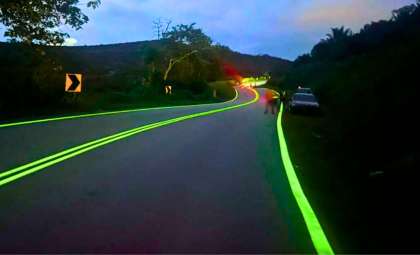
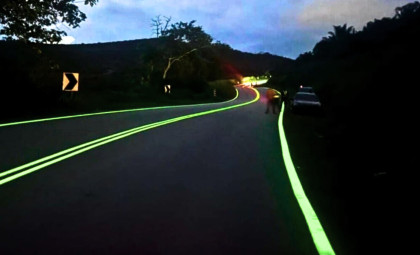
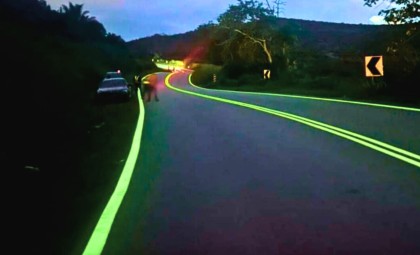
In a remote area near Semenyih, Selangor, Malaysia introduced innovative road markings that emitted light after dark without depending on street lamps. The glowing lines were applied at the junction of Jalan Sungai Lalang and Jalan Sungai Tekali, addressing a spot that had posed visibility challenges at night prior to the trial.
During an inspection, Works Minister Alexander Nanta Linggi highlighted that these photoluminescent road markings could shine for as long as 10 hours. He noted the markings also maintained a noticeable glow even in wet conditions. The Straits Times reported in late 2023 that this stretch lacked street lighting before the new markings appeared.
However, an immediate challenge emerged: expense. The specialized photoluminescent paint cost around RM749 per square meter, a steep contrast with the traditional road paint priced at RM40 per square meter. By November 2024, Deputy Works Minister Ahmad Maslan announced to the Dewan Rakyat that the government was unlikely to pursue further use of these glowing lanes.

“Due to the high cost, it’s improbable we'll proceed with glow-in-the-dark lane markings,” Maslan commented. Besides financial concerns, he mentioned that the paint's performance failed to meet standards set by ministry professionals: “Testing was conducted, but it fell short of ministry experts’ expectations.”
Selangor's 245-Meter Pilot Section Marks the Beginning
The initial experiment took place on a 245-meter portion near Semenyih. The Hulu Langat Public Works Department utilized this site, at the crossroad of Jalan Sungai Lalang and Jalan Sungai Tekali, to trial the luminous strips as an alternative to the conventional cat’s eyes road reflectors.
This location choice allowed close observation of the markings in an unilluminated environment. According to The Straits Times, the stretch had previously posed difficulties for nighttime travelers. After visiting, Nanta affirmed the glow’s endurance up to 10 hours and noted visibility during rainfall.
Even during early stages, cost remained a major consideration. Nanta stated the ministry was assessing the overall effectiveness and cited the relatively high expense involved.

Public feedback gathered by The Straits Times showed mixed reactions. While many appreciated the concept, advocating for its expansion to highways and rural roads lacking illumination, others suggested that priority should be given to improving existing road infrastructure like traditional lane paints, signage, pothole repairs, and surface leveling.
Plans to Expand Trials in Selangor and Johor
The Semenyih project quickly prompted plans for broader implementation. By February 2024, the Selangor state government announced intentions to roll out the technology across 15 additional sites, covering roughly 15 kilometers in districts including Sepang, Kuala Langat, and Petaling, as reported by paultan.org.
Similarly, the state of Johor eyed a larger-scale evaluation. It shortlisted 31 roads for pilot markings, including a 300-meter portion of Jalan Paloh J16 in Batu Pahat, in an effort to assess the safety benefits for motorists.

These initiatives reflected ongoing efforts to determine if the photoluminescent technology could be applied more broadly beyond the original test site. Yet, the price gap kept emerging as a significant hurdle. Nanta quoted the paint’s cost at RM749 per square meter, compared to standard road paints costing only RM40 per square meter.
Experts Express Disappointment Over Test Performance
By late 2024, the government’s stance had altered. Deputy Minister Maslan, addressing the Dewan Rakyat, linked the halt in expansion to two main factors: the high material cost and the subpar technical results.
The cost disparity was striking, with photoluminescent paint almost 19 times more expensive than conventional paint. Maslan indicated that this difference made further investments in the glowing paint improbable.

The ministry's evaluation also failed to meet expectations, although Maslan did not specify which exact criteria were lacking. He was firm in stating that the ministry’s specialists were dissatisfied with the trial outcomes.
As a result, proposed expansions in Selangor and Johor lost momentum. While Malaysia’s trial demonstrated that the glowing markings could perform well in unlit and rainy conditions for hours, by November 2024, the combination of RM749 per square meter costs and unsatisfactory testing results led the Works Ministry to conclude that further rollout was unfeasible.
- Categories:
- News






0 comments
Sign in to Comment