

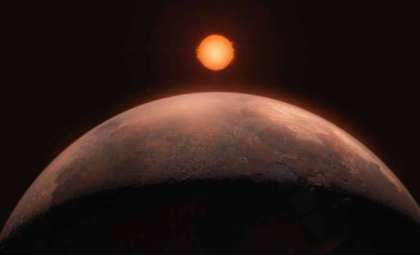
Astronomers have identified Gliese 523b, an extraordinary exoplanet notable for its vast size, remarkable density, and an unconventional orbit around its host star. Situated approximately 87 light-years from Earth, this youthful planet challenges existing theories about planetary development.
Orbiting the smaller K-type star Gliese 523 every 17.75 days, this planet, also referred to as GJ 523b, measures roughly 2.55 times Earth’s radius and weighs in at nearly 23.5 times Earth’s mass. It might become one of the most definitive examples of a mega-Earth ever observed.
Scientists at the University of Wisconsin-Madison highlight that Gliese 523b exhibits a density of 7.8 grams per cubic centimeter, far exceeding what is anticipated for a planet of its dimensions, indicating a surprisingly heavy elemental composition for its size compared to typical larger exoplanets.

This discovery was made possible by combining data from NASA’s TESS mission and high-precision measurements from the NEID spectrograph mounted on the WIYN Telescope at Kitt Peak National Observatory, enabling precise estimation of the planet’s physical properties and its unusual orbital pattern.
A Massive Rocky World That Challenges Expectations
The key surprise with Gliese 523b is its combination of considerable size and exceptional density. Typically, planets larger than twice Earth's radius are expected to possess thick gaseous envelopes atop smaller rocky cores, but this planet appears to defy that trend.
“People have been using the phrase mega-Earth for more than a decade, but we’ve never had a planet that let us say concretely what one is,” said Thomas Beatty, an astronomer at the University of Wisconsin-Madison.
This discovery offers a unique opportunity to explore a planet that bridges known classifications. While smaller rocky worlds like Earth and Mercury tend to have higher densities, larger planets usually feature substantial gaseous layers.

Gliese 523b doesn’t comfortably fit into either group. It was initially detected by the slight dip in starlight as the planet transited its star, revealing its radius. The interval between transits indicated an orbital period of 17.75 days. Subsequently, radial velocity data provided mass measurements.
“This isn’t what we expected at all,” said Max Kroft, a graduate student at the University of Wisconsin-Madison. “Dense planets like this aren’t uncommon, but they’re usually small rocky planets similar to Earth or Mercury. This planet is two and a half times bigger than the Earth.”
A Young World Following an Unexpected Orbital Path
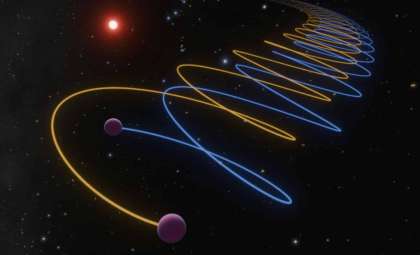
Beyond its composition, Gliese 523b puzzles researchers with its orbital tilt. Its orbit is inclined by at least 71 degrees relative to its star’s equator, suggesting it may travel over the star’s poles rather than along the equatorial plane like most known planets.
The planetary system hosting Gliese 523b is estimated to be around 169 million years old, with age assessed by studying the star’s rotation and its association with neighboring stars moving through space.
The fact that such a youthful system harbors a planet in this markedly tilted orbit prompts questions about its formation. Classical models fail to easily account for a large, ultra-dense planet with such an atypical orbital inclination.

Current theories under consideration include the influence of an unseen planetary companion or an initially misaligned protoplanetary disk impacting the planet’s orbit.
A Survivor of Past Celestial Turmoil?
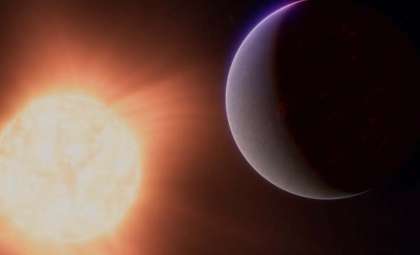
Researchers also speculate that Gliese 523b may have undergone a significant collision, where a giant impact stripped away much of its atmosphere, leaving behind its dense rocky core.
Kroft suggested another scenario where the planet migrated close enough to its star for its atmosphere to be eroded by intense stellar heat. “It kind of blows away,” he described, illustrating how extreme conditions can remove a planet’s gaseous layer.
These remarkable characteristics imply an unusual evolutionary history that suppressed the planet’s gaseous envelope development. The detailed findings were published in the Astronomical Journal, shedding light on the origins of this rare mega-Earth.
- Categories:
- Science







0 comments
Sign in to Comment