

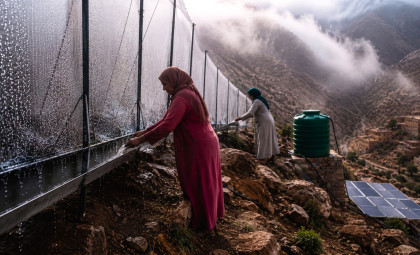
Perched atop Mt. Boutmezguida in southwestern Morocco, rows of black polymer mesh stretch over 4,000 feet above sea level. As Atlantic fog drifts through the Anti-Atlas Mountains, moisture condenses on these meshes. The collected water flows into reservoirs before being piped down to the residents of Aït Baâmrane, offering a source that originates not from surface water or wells but directly from the air.
This fog water harvesting system is managed by Dar Si Hmad, a Moroccan nonprofit that pioneered the use of fog as an alternative freshwater source in 2006. A Reach Alliance report highlights how these installations reliably provide clean drinking water to individual households in this incredibly dry region of the Anti-Atlas.
Before the system was in place, families relied on wells located far away, requiring rural residents to spend up to four hours daily fetching water. Women often bore the burden, carrying 5-gallon containers weighing nearly 50 pounds atop their heads, as documented by The New Yorker.

Fog Nets Channel Mountain Mist Into Village Water Supplies
The concept is straightforward. Sturdy steel frames hold vertical nets in the path of Atlantic fog sweeping across the mountains. As moisture gathers on the mesh, it drips down into a catchment system. Gravity then transports the collected water downhill to the communities below.
At Mt. Boutmezguida, these nets can harvest as much as 17 gallons per square yard over a 24-hour period. The New Yorker’s 2016 article details the CloudFisher technology employed, showcasing the innovative fog-trapping mesh design.

Engineers enhanced the nets by tweaking mesh size, fiber types, and coatings, boosting fog collection efficiency by around 500 percent, according to Gareth McKinley of MIT’s School of Engineering. This Moroccan system is not only more efficient but also more resilient and easier to maintain locally compared to earlier designs deployed in Eritrea, Chile, and Yemen decades ago.
The method of harvesting fog has ancient origins; as noted by The New Yorker, it was referenced by Bartolomé de las Casas in his 16th-century History of the Indies. The current project fuses these traditional roots with modern mesh innovation, reservoir storage, and piping infrastructure.
A Tap Installation Transforms Daily Water Access
When the CloudFisher network officially began operation in 2015, the community gathered to witness water flowing from a household tap for the first time. A ceremonial crystal glass was filled and shared among attendees. This water soon became affectionately known in French as l’eau du brouillard, or fog water.
Jamila Bargach, who co-founded and directs Dar Si Hmad, described her pride at the accomplishment, saying, “On days like today, I am the queen of fog,” in an interview with The New Yorker.

Having piped water reduced the need for many families to undertake frequent trips to distant wells. Fadma, a 52-year-old grandmother who initially doubted the project’s viability, eventually embraced fog as a dependable water source. Her granddaughters now regularly attend school, illustrating the far-reaching benefits of improved water access.
However, acceptance wasn’t immediate. Some locals were skeptical since water that bypasses the soil was thought to lack vital minerals and the qualities associated with 'living water,' important for both hydration and spiritual practices.
Dar Si Hmad Combines Infrastructure With Education Initiatives
Introducing tap water also altered family dynamics; women who traditionally managed water acquisition and control sometimes experienced a shift in their domestic influence once water flowed by pipe.
To address this, Dar Si Hmad launched a water education program emphasizing conservation and sustainable usage of the new resource. This initiative sometimes included literacy and numeracy lessons, empowering villagers to perform tasks like reading phone numbers or reporting leaks early to prevent damage to their homes.

A Reach Alliance report highlights the project's integrated approach, combining innovative technology and active community involvement, including the roles women play. The report emphasizes the Anti-Atlas Mountains as a harsh, water-scarce environment inhabited by Amazigh populations.
Since 2006, Dar Si Hmad has been refining fog harvesting techniques in this region, delivering clean water directly to households. The system’s success hinges on Mt. Boutmezguida’s environmental conditions: consistent fog, elevated terrain, and adequate atmospheric moisture allowing nets to gather water before gravity channels it downward to the villages below.
- Categories:
- News





0 comments
Sign in to Comment