

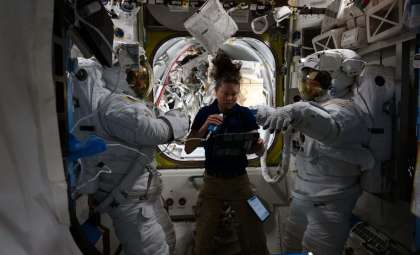
On August 6, NASA astronauts Jessica Meir and Anil Menon conducted a 6.5-hour extravehicular activity (EVA) outside the International Space Station (ISS), completing the installation of the last mounting components essential for upcoming solar panel upgrades, according to NASA. This milestone advances efforts to enhance the station’s electrical generation capabilities, vital for ongoing science experiments and future space endeavors.
During their spacewalk, the crew prepared and installed hardware for a new ISS Roll-Out Solar Array (iROSA) to be set up on the station’s 3B power channel. This setup paves the way for additional solar wing deliveries that will boost the ISS’s energy output in the near future.
The EVA also reminded observers of the link between ISS operations and NASA’s broader exploration ambitions, as the astronauts observed the Moon while installing technologies that support extended human missions in space.

Essential Hardware Installation Advances ISS Solar Upgrade
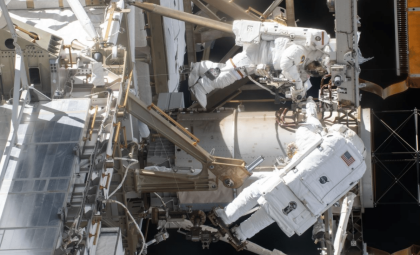
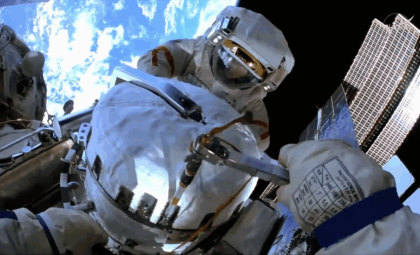
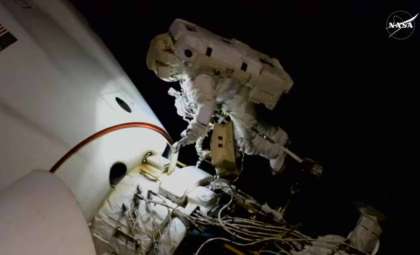
During the EVA, Meir and Menon attached the seventh and last set of mounting brackets required for future iROSA solar array installations. The hardware was fixed to the starboard-side S6 truss segment, preparing the station to support new roll-out arrays.
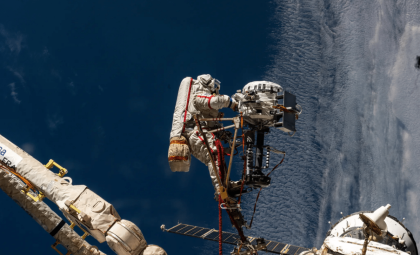
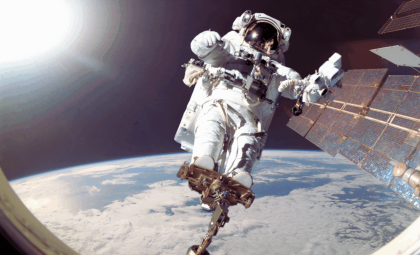
The astronauts carried out complex assembly work reminiscent of orbital construction, fitting triangular mounts and securing them to existing structural elements. Menon operated from an articulating portable foot restraint (APFR), which held him steady as he worked outside the station.
Following hardware installation, the duo routed cables to transmit electricity from the anticipated solar arrays into the 3B power bus. They also wrapped the area in multi-layer insulation to shield the system against micrometeoroid damage.
According to NASA, these new solar arrays will supplement the original panels instead of replacing them, as the older wings have seen diminished performance after surpassing their designed 15-year lifetime.
Once fully installed, this upgraded solar system is expected to raise the ISS’s available power by roughly 20% to 30%, ensuring the station can support its mission objectives throughout its remaining operational life in orbit.
The Moon Witnessed During Critical ISS Work
The astronauts took a moment during their spacewalk to glimpse the Moon, connecting their current task on the ISS to NASA’s ambitions for lunar exploration. Meir spotted the lunar surface and shared the sight with Menon.
“Anil, you can see the moon to the — well, I am not sure what way you’re facing, but…,” said Meir, taking a short break during the spacewalk to notice NASA’s next destination for astronauts under its Artemis program.
“To my right. Yeah, I see it — thanks for the heads-up,” said Menon. “I can see a future moon base there.”
“I can see it, too!” Meir replied.
This exchange underscored the ISS’s role as a testbed supporting future missions beyond Earth orbit. The station has been crucial for developing technologies and operational know-how essential for journeys to the Moon and Mars.
Reflecting on past achievements, Meir mentioned another landmark in space exploration: NASA’s Curiosity rover mission on Mars.
“On this day in 2012, NASA’s robotic rover Curiosity successfully landed on the surface of Mars with the goal of understanding if the planet could have fostered life. Curiosity achieved that goal within a year,” she said. “One day, humans will visit Curiosity, propelled by the groundbreaking science, technology demonstrations and operations conducted here on the International Space Station for almost 26 years now.”
Ongoing Efforts to Modernize Station Infrastructure
The spacewalk was the first EVA for the Expedition 75 crew and a career milestone for Menon, marking his debut spacewalk. Meir, meanwhile, logged her sixth EVA.
The activity lasted 6 hours and 27 minutes, starting at 8:33 a.m. EDT when the astronauts powered their suits via internal batteries and concluding at 3:00 p.m. EDT as they returned to the Quest airlock.
This excursion was the 96th U.S. spacewalk and the 281st overall aimed at building and upgrading the ISS.
With this final mounting hardware installed, only two remaining iROSA units await delivery and setup. Since 2021, six arrays have already been deployed, bringing the station closer to completing an extensive power system overhaul.
NASA is also planning additional spacewalks later in August, focusing on equipment replacement, power and data system connections, and essential maintenance as the ISS transitions to its next operational phase.
ISS Power Upgrades Propel Next Era of Space Research
This recent EVA shows how crews continue to upgrade the ISS to meet evolving mission demands after nearly 30 years in space. The enhanced solar power system will sustain ongoing scientific investigations and enable preparation for NASA’s upcoming human exploration ventures.
“Today, we made one more step toward expanding the ISS power system, further sustaining our human presence in low Earth orbit, as we prepare to take those next steps,” said Meir.
With further solar upgrades planned, the ISS remains a pivotal platform linking current space science with NASA’s ambitious goals for exploration beyond Earth orbit.
- Categories:
- News





0 comments
Sign in to Comment