

The Jet Propulsion Laboratory at NASA has successfully tested an ultra-light radar antenna designed for upcoming SkyFall Mars helicopter missions. This advancement paves the way for aerial vehicles to examine Mars' surface in unprecedented detail.
Innovative Radar System Tailored for Mars Aerial Exploration
The antenna, crafted for the SkyFall helicopter concept, supports extensive Mars exploration through multiple flights carrying scientific tools. Unlike ground rovers, this airborne device can cover vast territories and access places that are otherwise inaccessible.
This antenna forms a crucial part of the ground-penetrating radar setup aimed at gathering data beneath Mars' surface during flight. By operating radar instruments while airborne, the helicopter could unveil subsurface formations, geological layers, and hidden terrain features.

Creating this hardware involved overcoming significant challenges, as it needed to stay lightweight enough for a small helicopter while enduring repeated takeoffs, landings, and stressful environmental conditions. It also had to be compact and robust enough to withstand operational demands.
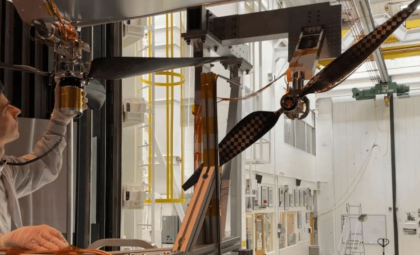
The development and testing were undertaken by NASA's JPL team, who evaluated whether the antenna structure could tolerate the mechanical stresses expected in Mars explorations. The testing yielded valuable insights into the antenna's performance under simulated mission conditions.

The Engineering Challenge of Building a Compact Yet Resilient Antenna
SkyFall’s antenna utilizes a Vivaldi design, a broadband type that offers radar functionality while maintaining low weight. Its length extends beyond the helicopter's landing gear, introducing a unique challenge.
“Although we managed to shrink the antenna quite a bit, it is about 1½ times longer than the helicopter’s legs,” said Christine Gebara, SkyFall ground-penetrating radar mechanical lead at JPL. “That means during landing, the Vivaldi has to bend out of the way — and if it lands on a rock, it bends even further. But when the helicopter takes off again, the antenna must spring back into place for data collection. Because SkyFall is expected to make dozens of flights exploring Mars, we needed an antenna that could repeatedly handle those pressures without losing its shape in flight.”
To address this, engineers designed the antenna to not only withstand bending but also to return reliably to its original form after stress. This combination of flexibility and strength is essential for mission success.
Flying conditions on Mars differ drastically from Earth, featuring thin atmosphere and rugged landscapes, which demand components that are extremely durable and capable of long-term operation without maintenance.
Key Testing Milestone for SkyFall Antenna Development
Recent assessments focused on how well the antenna tolerates continuous mechanical forces during operational cycles. The team observed its response to bending and its ability to resume a functional position afterward.
“This test checked every box it was supposed to and answered our biggest technical questions,” said Tang. “While we still have work ahead of us before the antenna is fully flight-qualified, this was a major milestone, and the hardware performed exactly as expected.”
The successful outcomes strengthen the SkyFall team’s confidence as they push forward with further qualification tests. The antenna remains under evaluation before being integrated into active Mars helicopter missions.
This project highlights a trend in space exploration towards compact, lightweight spacecraft components enabling complex mission capabilities. Mars helicopters have already proven powered flight is feasible on other planets, and new instruments like this radar will expand their scientific reach.
Expanding Mars Exploration Through Airborne Radar
Equipping a helicopter with radar technology provides scientists a new vantage point for studying Mars. While rovers are limited by surface obstacles and slow speeds, an aircraft can survey wide regions and access challenging zones from above.
Airborne ground-penetrating radar can map subsurface geology, pinpointing areas of interest more efficiently and helping prioritize targets for further investigation by other robots or missions.
The advancement of the SkyFall radar antenna underscores how mission engineers innovate to adapt technologies for pioneering planetary aerial science. Each successful test brings these transformative missions closer to launch.
- Categories:
- News





0 comments
Sign in to Comment