

The forthcoming space observatory dedicated to unveiling the universe’s secrets will also carry a unique human touch across the cosmos. NASA has embedded a memory device containing 1,350,144 names within the Nancy Grace Roman Space Telescope, turning this groundbreaking mission into a collective tribute. When the telescope embarks on its journey this summer, it will travel nearly one million miles from Earth, launching into a realm poised to usher in new eras of space discovery.
A Compact Device with a Powerful Symbol
Though small in size compared to the vast observatory, the memory card holds immense significance. It stands as one of the most personal touches ever included in a flagship NASA science mission.
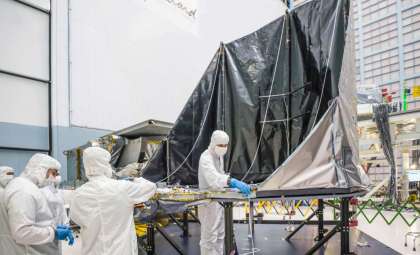
On July 27, technicians at NASA’s Kennedy Space Center in Florida carefully integrated the memory card into a commemorative plaque affixed to the telescope. This step concluded a global public campaign inviting people around the world to submit their names for inclusion aboard the spacecraft.

The campaign gathered a final tally of 1,350,144 names, representing participants from diverse countries and communities. Included among them are astronauts slated for the Artemis II and Artemis III missions, linking this advanced telescope with NASA’s upcoming human lunar expeditions.
While the names do not serve a scientific role, they embody a broader significance. They transform the mission from a technical endeavor into a shared human experience, allowing millions worldwide to connect personally with one of the most advanced telescopes ever built.
Once in space, these names will remain a part of the telescope throughout its mission, as it aims to revolutionize our understanding of the cosmos.

The Significance of the Roman Space Telescope
The Nancy Grace Roman Space Telescope stands out as more than merely another tool for observing the universe. It is one of NASA’s key scientific missions for the next decade, designed to tackle enduring astronomical mysteries.
Boasting a vast field of view and cutting-edge sensors, the telescope will scan expansive areas of the sky with exceptional speed and detail. Scientists anticipate that it will probe the enigmatic properties of dark energy, map the distribution of dark matter, identify thousands of far-off exoplanets, and chronicle galaxies across cosmic time.
Unlike instruments focusing on narrow sections, this telescope combines high sensitivity with wide-angle imaging, enabling extensive study of the universe at unprecedented scales. Its observations will complement those of the James Webb Space Telescope, with each contributing distinct capabilities to modern astronomy.
The observatory embodies decades of technological advancement and scientific design, engineered to withstand space’s harsh conditions while maintaining exceptional precision for years.
For researchers globally, the Roman telescope promises unparalleled insights into the universe’s evolution following the Big Bang.
Honoring the Visionary Dr. Nancy Grace Roman
Named after Dr. Nancy Grace Roman, widely esteemed as NASA’s first chief astronomer and a pioneering leader, the telescope pays homage to her legacy.
Roman championed placing major astronomical observatories above Earth’s atmosphere to avoid distortion, laying groundwork for future space telescopes. Her advocacy fundamentally transformed how scientists explore the cosmos.
She also promoted open sharing of scientific data, a principle that defines many NASA missions today, allowing researchers worldwide to access discoveries rather than restricting them to select institutions.
According to NASA, naming the telescope after Roman honors both her scientific legacy and her vision for inclusive and collaborative space science. The memory card with over a million names reflects this ethos by symbolically linking the public with the mission.
This tribute resonates with Roman’s lifelong conviction that exploring space is a universal pursuit benefiting all humankind.
The Telescope’s Million-Mile Orbit
After launch, the observatory will not remain tethered to Earth but instead journey to the Sun-Earth Lagrange Point 2, or L2, situated about one million miles from Earth.
This gravitational sweet spot allows spacecraft to hold a stable position with the Sun, Earth, and Moon aligned on the same side, offering an excellent vantage point for detailed astronomical observations.
Several prominent space observatories, including the James Webb Space Telescope, operate at L2. The location provides steady temperatures, minimal Earth interference, and clear views of the deep universe, making it ideal for cutting-edge astronomy.
Upon arrival, the Roman telescope will undergo an initial commissioning phase before commencing its science missions. Researchers expect years of data collection that could uncover new planetary systems, chart billions of galaxies, and deepen our grasp of fundamental physics questions.
Meanwhile, the memory card installed at Kennedy Space Center will accompany every scan and data point, carrying the more than 1.35 million names as the telescope surveys distant frontiers of the cosmos never seen with such clarity.
Uniting Humanity with Cosmic Exploration
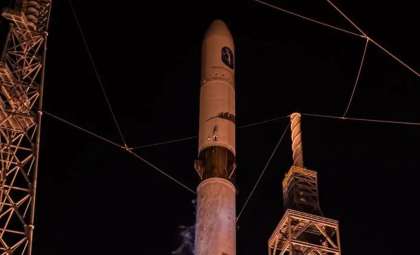
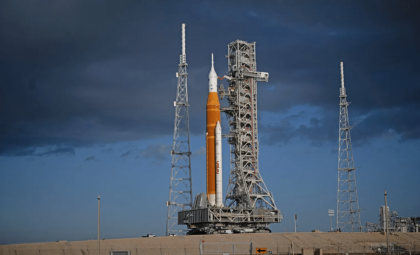
NASA and SpaceX have set a tentative launch date of no earlier than 7:26 a.m. EDT on Sunday, Aug. 30, utilizing a Falcon Heavy rocket from Launch Complex 39A at Kennedy Space Center.
This event will mark the launch of one of NASA’s most eagerly awaited scientific missions and also deliver a powerful symbol that space exploration is a collective journey. Each name on the memorial memory card represents a person who chose to join this voyage, making the mission a shared human venture.
As the rocket carries its advanced instruments skyward to probe the deepest mysteries of space, it will silently also hold a unique testament of global participation—more than a million names traveling together toward the vastness of the universe alongside one of NASA’s most ambitious observatories.
- Categories:
- Nasa





0 comments
Sign in to Comment