

NASA’s PUNCH (Polarimeter to Unify the Corona and Heliosphere) mission has pioneered a new approach for forecasting the arrival of solar eruptions at Earth. By continuously imaging a coronal mass ejection (CME), researchers were able to predict its arrival time within a 30-minute window during an initial demonstration study.
This advancement represents a major leap forward in monitoring space weather phenomena that can disrupt satellites, power grids, and space missions. The results were unveiled at the Committee on Space Research Scientific Meeting and are currently undergoing peer review by the journal Space Weather.
Previously, following these eruptions across their entire path was challenging because observations only covered a small portion of the distance from the Sun to Earth. This limitation meant scientists had to infer the CME’s behavior once it left the observable range.

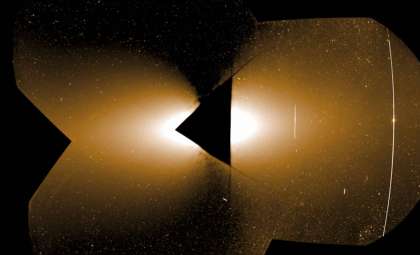
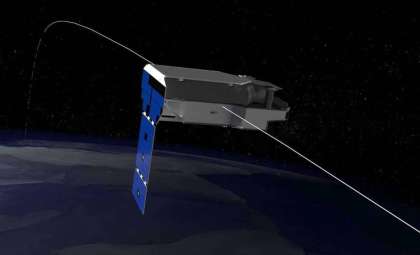
However, with the 2025 launch of PUNCH, scientists gained a new capability. The mission’s four satellites orbiting Earth provide uninterrupted three-dimensional imaging of the inner solar system, capturing a fresh view every four minutes.
Revolutionizing Solar Storm Monitoring
Before PUNCH, researchers could only track a CME for around 20% of its journey from the Sun to Earth. The remaining distance was mostly unobserved, increasing prediction uncertainties. With its broader perspective, PUNCH enables scientists to observe solar eruptions much further along their travel through space.
According to a statement by NASA, the mission can now consistently monitor these solar plasma clouds almost all the way to Earth, providing insights into their motion and evolution. Researchers applied this capability to a CME launched from the Sun on May 31, 2025, using continuous imaging data to refine arrival-time predictions via a computer model tracking the leading edge through the inner solar system.

The model incorporated measurements of the CME’s velocity and shape to forecast its arrival at Earth. About twelve hours following the eruption’s start, the system finalized an estimate predicting impact in eight hours.
Solar Storm Timing Forecasted with 30-Minute Precision
This timing prediction had an accuracy within half an hour, which is approximately ten times better than existing models that typically offer a five-hour margin. Craig DeForest, PUNCH’s principal investigator at the Southwest Research Institute, called the achievement exceptional.
“We thought PUNCH would be good at this, but it’s a stunning result,” he said. “To put it in perspective, this could be the space weather equivalent of going from a steam engine to a modern internal combustion engine.”

DeForest attributed the improvement to a straightforward method enabled by uninterrupted CME observation throughout its path.
“We accomplished an order of magnitude better result than the state-of-the-art method with a really basic process, just informed by the fact that the coronal mass ejection could be tracked continuously across the solar system.”
The model also indicated when its predictions had stabilized, providing space weather experts with reliable timing confidence.
PUNCH Unlocks Unprecedented Views of Solar Plasma Dynamics
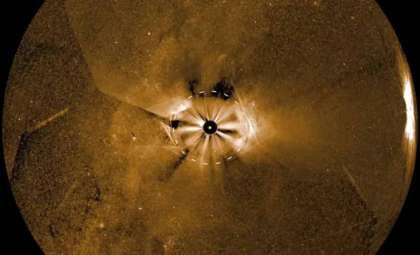
PUNCH is also enriching our understanding of the architecture and development of coronal mass ejections. Its high-definition images reveal that these plasma clouds are more intricate than once assumed, showing fragmented structures that transform as they traverse space.
As detailed by the Southwest Research Institute, PUNCH’s observations shed light on how plasma—solar material carried by CMEs—propagates throughout the solar system. These findings could improve knowledge of plasma behaviors in other cosmic environments, such as star-forming interstellar regions.
“These first results demonstrate the power of PUNCH’s wide-field imagery to track the solar events as they travel out from the Sun,” stated the U.S Space Agency.
As PUNCH collects more observations, scientists anticipate refining their understanding of CME propagation and improving space weather forecasting accuracy.
- Categories:
- News



0 comments
Sign in to Comment