

Recent laser scanning in the southwestern Amazon rainforest has revealed a far more intricate and densely inhabited ancient society than previously believed. This culture, dubbed the Aquiry, may have supported millions during its height, with current findings representing only a fraction of its true extent.
Historically, the Amazon was depicted as an untouched, sparsely populated wilderness before European arrival. However, continuous archaeological discoveries are dismantling this view. The latest evidence deepens our understanding, highlighting how populous and sophisticated the Amazonian civilizations truly were.
Published on July 29 in Nature, the research was conducted by archaeologist Martti Pärssinen of the University of Helsinki. Central to this breakthrough is lidar, a laser-based technology capable of rendering detailed 3D images through thick forest canopies, uncovering structures previously hidden from view.

An Unexpected Ancient Society Emerges
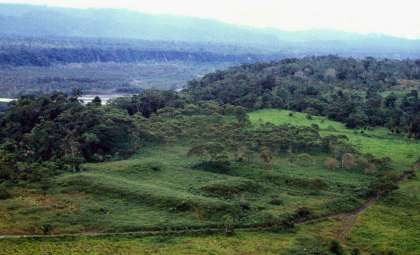
The team surveyed an area of 1,740 square miles in northern Brazil, detecting nearly 400 geoglyphs—carefully crafted geometric earthworks formed by ditches and raised banks. Extrapolating from these findings, the researchers estimate the Aquiry civilization flourished between 100 and 300 C.E. At its peak, its population may have reached 1.25 to 3 million people spread over more than 70,600 square miles of what is now northern Brazil.
Surprisingly, these settlements were situated away from major river systems traditionally associated with large ancient communities. Additionally, the mapped area constitutes less than 3 percent of the entire Amazon basin.

If similar population densities existed broadly, the pre-European Amazon could have supported tens of millions of inhabitants.
Communities, Longhouses, and Gathering Spaces
The Aquiry people appeared to live in villages of roughly 300 residents, residing in communal longhouses and cultivating crops such as squash, maize, and manioc. They also harvested fruits from Brazil nut trees and peach palms. With settlements dating back to about 600 B.C.E., this civilization endured for over a millennium before experiencing decline.
The geoglyphs themselves were not permanently inhabited but functioned as temporary areas. Martti Pärssinen explained to NewScientist that these sites served as:
“venues for gatherings, political decision-making and displays of chiefly generosity, ritual dancing, music, feasting, athletic competitions and ball games.”

Some earthworks display simple forms like circles and squares, while others show complex designs including octagons and layered shapes. Most cover approximately seven acres, with some extending up to 123 acres. Their ditches measure as wide as 40 feet and as deep as 16 feet, all constructed without the use of metal tools or animal labor.
An Abrupt Decline
Currently, about 1,700 geoglyphs have been documented, but experts believe the overall count may range between 23,000 and 30,000, far exceeding previous estimates of roughly 10,000. Pärssinen remarked:
“We do not know why the geoglyphs were suddenly abandoned between A.D. 850 and 950,” adding that “the available evidence points to a relatively rapid collapse.” This decline may have coincided with the fall of other precolonial civilizations around the same time, including the Maya, Tiwanaku, and Wari.

Michael Heckenberger, an anthropologist at the University of Florida unaffiliated with this research, described the population figures as “mind-blowing” yet credible. He also emphasized the substantial gaps in knowledge concerning these earthworks’ surrounding environments, underscoring the need for further exploration of the region.
- Categories:
- Science






0 comments
Sign in to Comment