

Data from NASA’s James Webb Space Telescope suggest that Neptune’s inner satellites might be remnants of a primordial moon system obliterated during the planet’s capture of Triton, as reported in Science Advances. These tiny moons near Neptune’s rings appear to retain chemical clues from icy worlds that existed billions of years ago.
Webb Uncovers Clues to Neptune’s Vanished Satellites
Scientists at Caltech utilized the capabilities of the James Webb Space Telescope to analyze three of Neptune’s small inner moons: Larissa, Galatea, and Proteus. Observing these faint objects had proven challenging due to their distance and limited visibility through conventional telescopes.
Infrared observations enabled the first-ever examination of their surface chemistry, revealing unusual mineral compositions that differ significantly from typical outer solar system bodies.

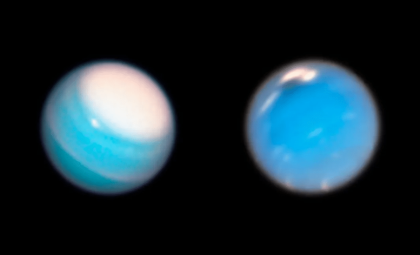
These insights bolster the hypothesis that Neptune once had a more conventional moon system, akin to the one orbiting Uranus, which may have been disrupted when Neptune gravitationally captured Triton, likely a Kuiper Belt object originating elsewhere.
“If Neptune once had a system of moons that looked something like what we see on Uranus today, we expect it would’ve been completely destroyed by the process of Triton getting captured,” says former Caltech graduate student Ryleigh Davis (PhD ’26), lead author of the paper.
“This is exciting new evidence that something catastrophic happened at Neptune that completely destroyed its original satellites, and we’re getting to see the fingerprints left behind by that process.”

Uncommon Minerals Indicate an Unexpected Interior
The research team detected magnesium-rich phyllosilicates, clay minerals formed through interactions involving liquid water, a surprising find beyond the orbit of Jupiter in the outer reaches of our solar system.
“Phyllosilicates hadn’t been observed in the outer solar system past Jupiter, so they weren’t originally on our radar,” explains Davis, now a postdoctoral fellow at UC San Diego. “Discovering these clay minerals indicates they must come from parent bodies far larger than Neptune’s small inner satellites.”

This mineral composition presents a puzzle: the outer solar system’s frigid environment normally preserves water ice in a frozen state for eons.
“This finding was surprising since this region should be dominated by icy surfaces,” Davis notes. “Therefore, these minerals point to origins within sizeable bodies capable of heating and melting ice, most likely a former icy moon system, though the fate of the melted ice remains unclear.”
The study published in Science Advances proposes that Neptune’s current moons might be reassembled fragments derived from larger celestial objects whose interiors became exposed following a violent event.
A Catastrophic Event Flipped Moons Inside Out
Scientists hypothesize that the ancient moon system was shattered, generating debris encircling Neptune, with portions coalescing over time into the moons and rings observed today.
This scenario allows researchers an exceptional glimpse into the internal composition of large icy bodies, normally inferred only through theoretical models and indirect observation.
“It took dedicated effort from Davis before we understood the significance of these findings,” explains Mike Brown, Caltech’s planetary astronomy professor. “Science sometimes uncovers unexpected evidence that challenges our initial assumptions.”
The analysis also detected an unidentified hydrated mineral spread among the observed moons. While known to contain water-based compounds, its precise nature is yet to be identified.
“There’s something unique here that doesn’t match any known solar system material in our spectral datasets,” Davis remarks. “We believe it’s a kind of hydrated rock from the moons, but much remains to be discovered.”
These chemical signatures imply the moons consist of fragments from deep beneath the surfaces of ancient icy worlds, rather than mere surface debris.

Neptune’s Moons Unlock Stories of Long-Lost Worlds
The study’s authors suggest a dramatic remodeling of Neptune’s satellite system, although another possibility exists: a sizable differentiated Kuiper Belt object, comparable to Pluto, might have ventured close enough to Neptune to be torn apart by tidal forces.
Both theories explain the presence of material in Neptune’s tiny moons that originates from substantially larger parent bodies.
“Regardless, these moons offer a rare direct window into the deep interiors of massive icy worlds,” Davis states. “Usually, such material remains hidden beneath surfaces, accessible only through modeling. Here, a catastrophic event flipped these moons inside out, revealing the concealed interior.”
Future investigations will aim to track the evolution of debris following Triton’s capture and determine how much material survived. Researchers estimate only a small fraction of the original satellite system remains today.
Upcoming studies could illuminate the original size of Neptune’s first moons and improve understanding of how planetary systems transform after significant gravitational influences.
- Categories:
- Astronomy


0 comments
Sign in to Comment